Wednesday, 20 August 2014

Dial H Book 2: Exchange (#9-15 Justice League #23.3)

"Kill that bastard!" - Nelson Jent

So you're DC.  Your New 52 relaunch has certainly been a sales success, but has divided your fanbase and generated very few critical successes. After a second wave launch of multiple new titles in 2012 one book that is getting plaudits is Dial H, a complex rejigging of the Dial H For Hero comic written by the acclaimed novelist China Miéville.  Unfortunately sales while decent are not stellar (though it apparently sold well enough to be called "The New York Times Bestselling Series" on the cover. Hmm), and so despite all the praise you cancel the book forcing Miéville to wrap up what was obviously planned as a much longer plot arc in a couple of issues.  Shame on you DC.  So we come to the second and final volume of Dial H, which collects the last nine issues plus a fun, post series one shot from the Justice League series called "Dial E" as part of it's "Villains Month" intiative.  The comics collected here are ridiculously textually dense, crammed with jokes, character moments, multiple twists and turns and I am having to summarise massively to keep this post from becoming a truly epic length, especially the second half of the book where it's obvious everything is having to happen in a big rush to let the book end on a definite and upbeat note. Probably the biggest casualties of this cut short run are the Dial Bunch, who were obviously designed to be explored in much greater detail than we get here. With that said then, let's crack on.
Of all the Heroes they dial, Daffodil Host is my favourite
Nelson and Roxie have been travelling the world, chasing up rumors of another dial.  This includes infiltrating a secretive cult devoted to the dials.  Roxie turns into a hero in front of one of the high ranking members to gain some specific information which sends them to a ruined qwater temple also devoted to dials, but the dial that was being worshipped is gone.  They do however find a clue that the Canadian military have been there.  They are also being tracked by a member of that organisation.  A man who was part of a failed military attempt to create a time machine.  Now he can generate multiple copies of himself at different points in his most recent timeline.  If something happens to his most recent body, he can jump back into an earlier one.  His hero name is The Centipede.  The Canadian military seem to be trying and failing to create a national hero, so they give the Centipede a stupid insect helmet and tell him he might have to do.  The Centipede meanwhile is keeping a secret from them which are Roxie's notes he lifted while tracking Nelson and Roxie.
The Centipede's tricky time travel abilty in action
The Centipede accosts Nelson out on the street and takes the H-Dial.  But when he tries to dial a hero it doesn't work.  Roxie appears, manages to dial herself up a hero who is a minotaur and traps the Centipede within a maze.  Later, Nelson as a hero called The Glimpse manages to infiltrate the Canadian military base where they have a dial that hasn't been working well for them.  They can dial a hero, but the dialler then just freezes up.  The Centipede tells the military dialler to dial a hero to deal with Nelson, so he turns into Bristol Bloodhound a giant rocket powered dog.  But when he goes to fight Nelson he finds himself compelled to do what Nelson tells him and flies himself and Nelson out of the base.  Later as he and Nelson are back to normal, Roxie appears and when the soldier tells them the number he dials is 7,4,3,3, Nelson realises he is dialling the word SIDE.  It's an S-Dial - a sidekick dial - that's why the soldier was compelled to obey Nelson while he was H-dialled.

Roxie and Nelson decide to test out the S-Dial.  Nelson says he's been losing himself while H-Dialed so he'll be the sidekick. They become a handsome and beautiful hero couple and go and deal with a bank raid:

Nelson:
"That surge again, that sudden knowledge of who I am.. And what I what I can do.  But this time there's an undertow.  Trust? Obedience? Whatever it is.. it's a relief!".

After they foil the raid, both of them are amped up about how well they worked togteher and suddenly Nelson plants a huge kiss on Roxie.
Roxie and Nelson about to have a bad idea
At the Canadian military establishment, the Centipede has the leader of the Dial Cult and has hooked him up to various machines so he can use him to attract the attention of the shadoqw on the line - The Fixer. Nelson and Roxie wake up in bed together.  They made love qwhile dialed and Neson is horrified, saying Roxie abused her H-Dial power over him.  He uses the H-Dial and turns into... The Flash!  This annoyingly leads into a two-part story in The Flash series which is not collected here.  In any case, Nelson comes to the conclusion that they were not copying powers but stealing them.

Nelson:
"Oh God. What've I done? What was he doing when I took his powers?"

The Centipede meanwhile has managed to bring The Fixer to him.  He tells him he wants to team up and that The Fixer missed a dial last time he was here (he had previously concluded that The Fixer has lost the ability to travel easily between dimensions and had to use something like The Abyss from book 1 as a way to reach Earth).  Roxie and Nelson meanwhile ponder the dial and wonder if the reason The Centipede didn't change when he dialled was because it didn't see him as a hero.  They are interupted by The Fixer and The Centipede suddenly appearing.  Nelson, still as the Flash, grabs Roxie and runs, ending up in Australia.  He then changes back, and The Fixer and The Centipede show up to attack them again, The Centipede grabs the H-Dial and tells The Fixer to deal with them.
Nelson as The Flash
Roxie snatches the H-Dial back, but The Centipede grabs it again.  The Fixer takes it from him and starts to switch it off.  Roxie uses the S-Dial and manages to knock the H-Dial out of The Fixer's hands while resisting his orders.  Nelson takes the H-Dial and Roxie flies him aqway to a building where they hide out.  Before they can talk about sleeping together, another hero appears, introducing himself as Open Window Man.  Nelson remembers him being Boy Chimney's sidekick.

The Centipede arrives on the scene and Open Window Man knocks him out of the building.  He then ports Roxie and Nelson through one window and out the next, travelling to the bottom of the building where The Centipede is.  The Fixer shows up as do a whole gang of Dialers called The Dial Bunch.  Using a portal they send The Fixer and The Centipede back to where The Fixer came from.  Although as this was where The Centipede wanted to go anyway, there is likely to be more trouble in store.
The Dial Bunch to the rescue!
The next chapter I really have to applaud for the imagination it shows.  The Dial Bunch, Nelson and Roxie have travelled to a world made up of grey walls.  The inhabitants of this world exist as graffiti on those walls.  It's here they have tracked down the legendary J-Dial, the Jump Dial that used to belong to Fixer and allows directed travel between worlds and dimensions.  Unfortunately they can't figure a way to get it out of the wall.  While the rest ponder, Open Window Man talks with one of the graffiti people who can see him, and fills in some background on the Dial Bunch and their mission.

Open Window Man: "We been fighting the Fixer, who killed Captain Random, for years. It's too tough to kill.  We thought we'd got rid of it a while ago, but we made a mistake. Sent something with it, something we need to stop."

Captain Random was the hero of this world, and owner of the J-Dial.  He explains that without the J-Dial they have to take backdoors through dimensions.  Same way The Fixer travels.  As they have journeyed they have come across evidence of multiple genocides with The Centipede's mask cast-offs proving he was involved.
Flashback to Baansa finding Open Window Man.
He says they are all dial-touched.  A human called Yaaba with a H-Dial; Nem, a cogsmith qwith a G-Dial who can summon random artefacts; Ejad, a robot dandy with a Dial Tapper, Dwan who has an Autodialler and finally Baansa who has a H-Dial that always steals rather than copies powers (and here it is confirmed Nelson stealing The Flash's power was a one-off) and who was responsible for the death of Boy Chimney by doing this. She doesn't use her dial anymore, but she's the one who can open doors through dimensions and find the Dial-Touched of those worlds.

Open Window Man:
"We hunt the Fixer who ends those who use these broken machines for justice. Like your Captain Random. And we hunted for new comrades. Became the Dial Bunch."

All the dials had been scattered through time and dimensions by a massive war in the Exchange.  To get to the Exchange they need the J-Dial.  The grafitti person then points out his world has windows and Open Windown Man has an idea.  He gets Nem to summon something with a window and travels through it into the graffiti world and gets a hold of the J-Dial. He returns with it and as the Dial Bunch make to leave, the graffiti person thanks Open Window Man for inspiring him to carry on the good fight, him being the graffiti worlds equivalent of a hero.
The graffitti world
Nelson: "Water worlds. Rust worlds. Worlds made of of light and worlds made of dark. Worlds underground.  Every world has its heroes.  Its gods. Its monsters"

They are on a world saving the froglike inhabitants from a monster.  This worlds has been taught to beware of dialers because of a "war".  Ejaad has also been killed here

They can't make the J-Dial qwork, so are still travelling via "frayed" spots in reality.  They arrive in a world being consumed by water and are attacked as being the cause.  When they explain they aren't they open another hole in reality and take the few inhabitants of that world with them.  But the hole closes before Nem and Yaaba can get through.

They are attacked again on this new world, by a strange, mechanical alien that lives there.  He threatens to hurt the civilians they have with them, so they surrender.

Alien: "Why did you come here? You think we'll let you steal powers again?  By Torque and Attrition, I remember the war.  And I will not allow you to restart it."
The big giant head of The Operator
Before he can elaborate on this mysterious war people keep referring to, a zombie attacks.  Then a giant head of a bald man appears in the sky, saying he is punishing this world.  And more zombies attack.  The alien allows our heroes to have their dials back and they fight them off.  Then the alien reveals they mended the J-Dial and so our heroes dial 0,0,0,0 and travel to the Exchange.

They are greeted by The Centipede, they battle him and beat him doqwn but Fixer arrives and grabs Nelson and takes him back into the Exchange building.  An edifice with many huge wires leading into it.

Baansa: "Wires channeling an infinity of worlds. Ripped out of eternity.  Ruined by war"
The Exchange
Back in the exchange, Nelson wakes up on a table, with Fixer standing guard over him.  The bald man introduces himself as The Lost Operator - O.  He has a D-Dial, a Doom Dial qwhich he can use to summon up random apocalypses.  He inflicts one on the world our heroes just left.

Nelson asks the Centipede why he is helping O.  The Centipede replies that when the H-Dial refused to work for him, judging him not a hero, he decided he wanted something else.  An E-Dial, EVIL.  And O has made him one.  Nelson then wants to know why Fixer is helping O.   He tells Nelson about the war.  How this was a world of diallers, and people in other worlds became afraid of them when their dials stole powers rather than copied them.  The worlds got together and attacked the Dial world, and it was destroyed apart from the Exchange where 0 created the D-Dial to take revenge on those worlds.

Fixer: "Perhaps it was our enemies portals making the exchange bleed. Or 0's amplifying machines destabilising realities and chronologies.  Or our terror.  Or the strength of our attacks.  But what happened was like nothing that had before."

There was an explosion that scattered dials through time, space and reality. Fixer had been loyal to a dead world, one that 0 helped kill.
Fixer reminices
Meanwhile Roxie, Baansa and Open Window Man have snuck into the Exchange.  They find an armory full of H-Dials and Roxie takes one. Centipede arrives to fight them, and by using an instruction manual for the dials they manage to temporarily fend him off.  Fixer then turns on 0, but 0 can turn off dials and disables the Fixer. Dwan and Roxie arrive, and Dwan can fight because his autodialler moves to fast to be disabled.  But 0 speeds it's changes up until Dwan can't move.  Roxie, Nelson, Baansa and Open Windown Man exit via a window.  Centipede arrives and kills Baansa.

Roxie reprograms a H-Dial with crossed wires inside.  This allows Nelson to transform into heroes that are a combination of each other, and means 0 can't turn his dial off.  0 uses an amplifier instead to grow huge.  Nelson keeps battling him to distract him while Roxie enters the Exchange and starts working on crossing the huge wires powering the Exchange.  This results in a build up of pressure that causes 0 to explode, also taking out the top of the Exchange where Roxie and Open Window Man managed to escape from just in time.  But not the Centipede who was trying to stop them. They survey the aftermath.
Nelson keeps O distracted
Nelson: "Hey, we stopped them.  We kinda did it.  And we're in the middle of a bunch of tangled universes. We saved history but we're beat up, hungry and stuck. But that's the exchange.  We got stuff to salvage.  To fire up.  You know this ain't the end of it.  We're dialers.  So lets dial."

But it is the end of it.  That's the final issue of Dial H alas. It wasn't quite the end of The Centipede though, who survived the explosion at the Exchange.  He showed up in Justice League #23.3 as part of Villains Month, chasing up his E-Dial which had fallen through reality into the hands of a gang of teenagers using it to create heroes.  The issue is most notable for having each page drawn by a different artist and ending with the Centipede getting knocked out by a dimensionally travelling hero called Rescue Jill.
The Operator and the Exchange go Boom
This second volume of Dial H does suffer a little from it's truncated run.  You can tell Miéville wanted more time to explore the Dial Bunch and the final showdown at the Exchange with 0 is contained in one issue which means things like Fixer's Heel Face turn seems to come out of nowhere.  That said, the fact this longer storyline crammed into a few issues still manages to make sense is a testement both to the artists and writer's command over their material.  Miéville created a wonderful team pairing in a world of glamorous perfect heroes having the main characters as a fat slob and a pensionably aged woman was a radical move.  Beating the final villain with a combination of her cleverness and his bravery was a fantastic end for the series.  There are enough concepts and characters thrown into these final few issues that could keep more "decompressed" titles going for years.  It's a tragedy that an intelligent and literate comic like this was cancelled.  Hopefully Miéville will write for comics again in the future and it's certainly made me keen to seek out his prose work now. If you enjoy way out science fantasy stories, Dial H is definitely a comic you need to read.

Saturday, 16 August 2014

Dial H Book One: Into You (#1-6, #0)

"We saved the town.  We saved the moon.  Even if we couldn't save everyone" - Nelson Jent

In 2011 DC initated the biggest, line-wide shake up of their comic book universe since 1985's Crisis On Infinite Earths.  Every single main DCU title was cancelled, while others were slated for later cancellation including several from the Vertigo and Wildstorm imprints (those characters DC wanted back in the main DCU like Swamp Thing, John Constantine and Stormwatch for example) and then fifty-two titles were launched beginning at issue #1, with the idea that this "New 52" as it is now known as, would always have fifty-two titles running at once.  If a new title was to be launched, an old one would have to be cancelled to make room.  This shake-up has proved controversial at the very least because every title was given an entirely new continuity, basically wiping out seventy-odd years of accumulated DCU history.  Because there has been so much controversy attached to The New 52, it's been hard figuring out which titles have been worth checking out.  But one title kept popping up in my perusing of various comics blogs as a title worth checking out and that comic was Dial H, written by acclaimed fantasy novellist  China Miéville and primary artist Mateus Santolouco.

It's a reboot of an earlier comic called Dial H for Hero, which is about a mysterious dial that, when the letters H, E, R and O are dialed, turns the user into a random superhero.  These are strictly ones designed only to appear in the Dial H comic (except later on in Book 2 when a major plot point turns on summoning up a well known DCU hero).  There have been a couple of exceptions, but only minor ones like Plasticman have been used in the past.  The first Dial H for Hero ran from 1966-1968.  Then it returned in the 80's as a back-up strip in various comics.  It returned again in 2003, entitled H.E.R.O, looking at the effect the dial had on it's users, at the end of it's 22 issue run the H-dial was sent back in time to 50,000 BC and there were no more stories based on the concept until the New 52 reboot in 2011.  Here all the characters associated with the series have been pruned from the narrative and a brand new storyline and history of the Hero-Dial instituted.
Darren and our soon-to-be hero Nelson
The action begins with one of our two main protagonists - Nelson Jent - being chewed out by his friend Darren over just having had a heart attack.  Nelson is not glamorously fit.  He's pudgy, unfit, a smoker and a depressive.  His friend leaves and Nelson chases after him to apologise for being rude to him.  He finds Darren being beaten in alley and he stumbles to a phone booth, he dials a number and in a flash, turns into a tall, skeletal creature called Boy Chimney, who deals with Darren's attackers and carries Darren to the hospital, while Nelson deals with a rush of memories that are not his own.  Finally he changes back.

The action cuts to a bald gangster who says they'll need more protection to deal with Darren if super-beings are involved.  After visiting to check in on Darren, Nelson returns to the alley and dials the number again in the booth.  This time he turns into Captain Lachrymose, and turns up at the bald guys hideout, causing him intense, crippling sadness.  He warns him to leave Darren alone. He goes back to the alley again and ponders to new found power he has access too:

Nelson: "It's impossible.  It's just a busted up phone. 4376.  Ain't even an interesting number.  Ain't a prime.  Ain't nothing.  But it's the number...'cause look, 4376 spells another word to.  HERO."
Boy Chimney in action
The next issue begins with Nelson doing "research" on how long the effect lasts and how long between transformations he can use the dial.  Finally he finishes and reflects:

Darren: "Time to change into the worst identity of them all".

Referring to himself.  Serious self-esteem issues there.  Nelson talks with Darren in the hospital and they discuss the epidemic of people falling into comas in the city.  Darren says it was his job to go to a newly comatose persons flat and steal their stuff, but they kept being interrupted in their work by a Hero.  Nelson later ponders this and his desire to "bust Darren's ass out of this mess".

He goe's and changes into a hero with a TV for a head called Ctrl-Alt-Del.  He goes to the apartment Darren was going to next and bumps into a hovering, cloaked purple figure, who attacks him.

Nelson: "Stop thinking like a schlub.  Start thinking like a hero."

And he uses his power to "reboot" the mysterious figure, who leaves.  As does Nelson, before Darren's crew are due to turn up.
Ctrl-Alt-Del versus Manteau
The action cuts to two gas masked villains discussing what happened, saying the woman Nelson encountered is called "Manteau".  One of the masked men attacks the other with black spit, then says he'll go take care of the problem.  He goes and melts his way through Darren's hospital window.  A panicked Nelson who had tried to reach Darren at the hopsital only to be told they can't get into his room, goes and changes into The Iron Snail.  A soldier with a huge metal shell.

He attacks the mobsters at the hospital and then gets into a fight with the reptile like creature who was attacking Darren and who seems to know who he is.  Before he can prevail, he starts to change back and goes rushing back to the phone booth, closely followed by the mobsters.  There he finds Manteau hovering over the phone booth.  She says she made a mistake attacking him.

Manteau: "You want to know how I knew to wait for you.  How that thing knew who you were. What the dial is.  What's going on.  I can help you".
Squid takes on The Iron Snail
The mobsters attack and in the crossfire the phonebooth gets damaged.  Manteau tells him to take just the dial, which he does, then she wraps a tentacle around him and they fly off.  The mobsters report back to a female who was a doctor at the hospital.  The reptile creature - who the Doctor calls "Squid" - says he knows she wants "something from nothing", while he just wants to go home.  But if they suceed, the emptiness will want something too.

Manteau flies Nelson to her house and tells him she might be able to fix his dial.  She also has one of her own.  She gives him a potted history of the telephone:

Manteau: "I'm saying Bell and Edison, all of them are lucky 0 wanted them to secretly swap thoughts.  I'm saying the entire history of telephony is a by product of someone elses research.  Reserach into something else altogether".

She then asks him what his biggest fight was and he channels a Boy Chimney memory.  She explains that she uses the same name, and costume so she can keep her own personality grounded when she changes.
Nelson and Manteau
In a car, the doctor and Squid plus two zombies, go and visit a man called Mr.King.  Some time ago his brother saw something years ago, and him being close to his brother means he can be used as a conduit to channel something.  One of the zombies then vomits black goo on him.

Nelson returns to Manteau who shows him she has been tracking Dial reports over the years.   She then dials into listen to Mr. King as he is being attacked, becuase he was close to the last big cluster of Dial incidents.  Nelson tries his dial and changes briefly, seeing a "shadow on the line" while he is changed.   Manteau tells him to try again and he changes into Baroness Resin.  He freaks out at this:

Manteau: "You been a giant metal spring yet? A super-disco dancer?  A boomerang? Now it's bust because you got ovaries?"
She tells him to "woman up" and they go to rescue Mr. King who has been strapped to a bed.  As Manteau and Nelson arrive, a huge black being bursts out of him.
The Abyss
Squid falls into a prayer position and thinks back to a thing that was lost:

Squid: "It fell through fast places, through anti-qworlds, through questionable realities that weren't sure whether they were there...like a punishment it's fall took it back to where it had first been trapped, fallen into something.. and it never stopped falling.  Until it did stop".

And he remembers the doctor rescuing him and telling him she wanted his companion back.  Back with the black being, the doctor tries to bind it, while it lashes out at Squid.  Manteau and nelson attack it and make it disappear.  The doctor blasts Manteau in the back with her binding gun, while Nelson transforms back into himself. 

The doctor tells Nelson she made herself a "nullo-mancer" Studying all these years to bring the Abyss back.  She and Squid then leave with the unconcious Manteau and her dial.  Nelson tries to dial another hero, but his dial seems permanently broken now.

Back in her lair, the doctor has Manteau strapped to a table, while the Abyss cause havoc in the city.  She says that Dial-wielders banished Squid and the Abyss, and she wants to know how.  Squid weakly asks if she could heal him, but she refuses.  Intent on finding out about the relationship between Dials and the Abyss she tortures Manteau, but she knows nothing.  The doctor then says she could boost her nullo-mancer power with the dial and bind the Abyss that way.
The Abyss
The Abyss is growing larger, and Nelson watches it on TV, quoting Nietzche's famous lines about gazing into the abyss.  Squid turns up at Nelson's flat, apologises for killing his friend Darren, then shows Nelson the huge hole the Abyss made in him.  He says all he ever wanted was to go home.  He explains his people are "null-herders", training and taming "the wild nothing".   He found one he could push even harder than normal and explored the universe with it, until it was the one in control.  And it was hungry.

Squid: "It is dark between the stars.  It is hungry for the light."

The dialers banished him for stealing jewellery while on Earth. The Abyss has lost itself and is getting stronger.  The doctor might make it mad enough that it remembers it can eat suns.

Nelson tells him that his dial is bust and all he can do is change into himself.  Squid says that will have to do.  So Nelson dresses as a super-hero and calls himself Rescue Jack and he and squid go to the hide-out and beat down the mobsters.  Nelson finds Manteau stripped of her mask and costume and she turns out to be an old woman.  He unties her and she dresses back up again and they go to leave.  Back with the doctor and the Abyss, it shows her whats happening at the hideout and she warps back to where Nelson, Squid and Manteau are, screaming "traitor!" at Squid.
Rescue Jack and Squid take on the mobsters
Squid takes on the doctor so Nelson and Manteau can make a getaqway and fix the broken dial.  Back at Manteau's house, she reintroduces herself as Roxie Hodder, and thanks Nelson for rescuing her. She tells him that in the sixties she was doing a Phd in Telephony when a "Joy festival" opened her mind to more spiritual uses for it.  Watching on TV, Nelson sees Squid even more badly injured, plus the doctor has dialled again, turning into a powerful hero called The Hairbringer.  The doctor is angry at the Abyss for it's ingratitude and starts to attack it in earnest.  Roxie finishes mending the dial and hopes she gets someone strong, before she can dial, Nelson snatches it from her and dials himself:

Nelson: "Come on.  No more crazy powers. This one matters.  This time we need a superman"

Roxie: "We're screwed"
Cock-a-Hoop to the rescue!
Nelson has turned into Cock-a-Hoop, a giant hoop with a chickens body attached. Oh dear. He goes into battle with the doctor and the Abyss. Meanwhile, military helicopters fire missiles at the Abyss, who just absorbs them.  Nelson uses his spin attack to confuse all the little Voids the Abyss is generating.  They turn on the Abyss and attack it.  It starts to turn into stone, then suddenly there appears another dialler, shifting forms fast.  It attacks the doctor and disables her dial.  She turns back into herself and as she was hovering way above ground, this does not end well for her.  Then the dialler fires a giant bullet into the head of the now stone Abyss and it finally dies, before disappearing as mysteriously as it appeared.
The dying Abyss and Hairbringer
Nelson, now back to his normal self, and Roxie check the doctor is dead and at the same time, Squid finally dies as well.  They don't celebrate their victory over the Abyss, because all they can do is ponder the being that attacked the doctor, the shadow on the line who targets dials.

Nelson: "That's what it's been hunting. You felt it on the line.  Since way before the Abyss turned up. That's what it came for... What's the shadow gonna do when it figures out we got another one."

And as they contemplate the half-broken dial, this arc comes to an end.  But it's not the end of the book.

We next get an amusing one shot that explores Nelson and Roxies growing, warm relationship as they share the dial.  Roxies is telling Nelson he can't go out looking like he does now, which is as a stereotypical "Red Indian" called Chief Mighty Arrow.

Nelson: "Ah come off it!  Enough with the political correctness BS. I got super arrows! Jet propelled explosive feathers! I'm heap big trouble for criminals... uh"

Roxie: "'Heap big?' Oh my God can't you hear yourself?"
Roxie scolds Chief Mighty Arrow
After chasing off the flying horse that came with his powers, Roxie shows Nelson her "Refusenik Dossier".  The I.D's even she as Manteau refused to use.  She says they were just too shameful, as Nelson peruses the photos.

Nelson: "What the hell is that?!"

Roxie: "That's Golliwog.  Dialled it in 2007.  They used to make dolls like that.  What kind of insensitve pig - or racist - would put that out in the world.!"

Ouch.  That is actually a meta reference and qwhat the hip hop community would call "a massive diss" aimed at Alan Moore putting the Golliwog (who has a large penis) in The League of Extraordinary Gentlemen: The Black Dossier, published in 2007.  I'd like to mount some spirited defence of Moore as simply appropriating the iconography of the fifties to make some kind of satirical point.  But I can't, some things are too toxic, too laden with negative meaning to be used that easily.  I don't think Moore is racist, but I think he made an error.  Still, getting a shot at him in a mainstream comic is funny, but better watch out China, lest a puppet snake God comes to eat your soul in the night!  Of course, Miéville is using dodgy imagery himself, but makes it clear that it's wrong and shameful so I think he about gets away with it.

Nelson agrees to stay inside, although he sulks.  Sweetly, Roxie kisses his forehead and agrees he can go out if someone is really in trouble.  They chat and Roxie tells Nelson about the last time she went out patrolling not as Manteau, she was sick and overwhelmed by half-memories when she changed back.  Nelson must protect his mind.

To be continued....
Later, as he restlessly watches TV he sees a hostage crisis taking place.  Before he can rush to the scene, his winged horse turns up there and craps all over the attackers, rescuing the hostages.  Disappointed, Nelson nearly falls asleep, but catches himself before he does so.  Falling alseep while dialled is a real no-no. Then another situation breaks out with a costumed attacker cause havoc in the town.  Before he can rush to the scene he changes back.  Roxie swipes the dial off him and changes herself, but as she does so she tells Nelson she might have tracked down another dial.

There is actually more in this collection with the inclusion of an issue #0 set in the ancient past, involving a primitive stone dial and travellers from the future.  However the real meat of this book is the relationship between Roxie and Nelson.  And also Nelson's journey from self-confessed "schlub" to an eager hero, who helped save the world.  The writing is excellent, melding goofy super-heroic stuff to a real core of hard fantasy concepts, with plenty of warmth and humour on the way.  The artwork is great as well, capturing both the epic and the intimate with ease, given some of the cosmic concepts written here, a lesser artist could have been completely stymied, but Mateus Santolouco pulls it off.  Enough on-going plotlines have been laid to make checking out the second (and sadly final) volume a real must.  Dial H proves that a full on reboot of somewhat corny concepts can be handled in an accomplished and literary style, while still staying try to the core ideas. Definitely the cream of The New 52 relaunch.

Tuesday, 12 August 2014

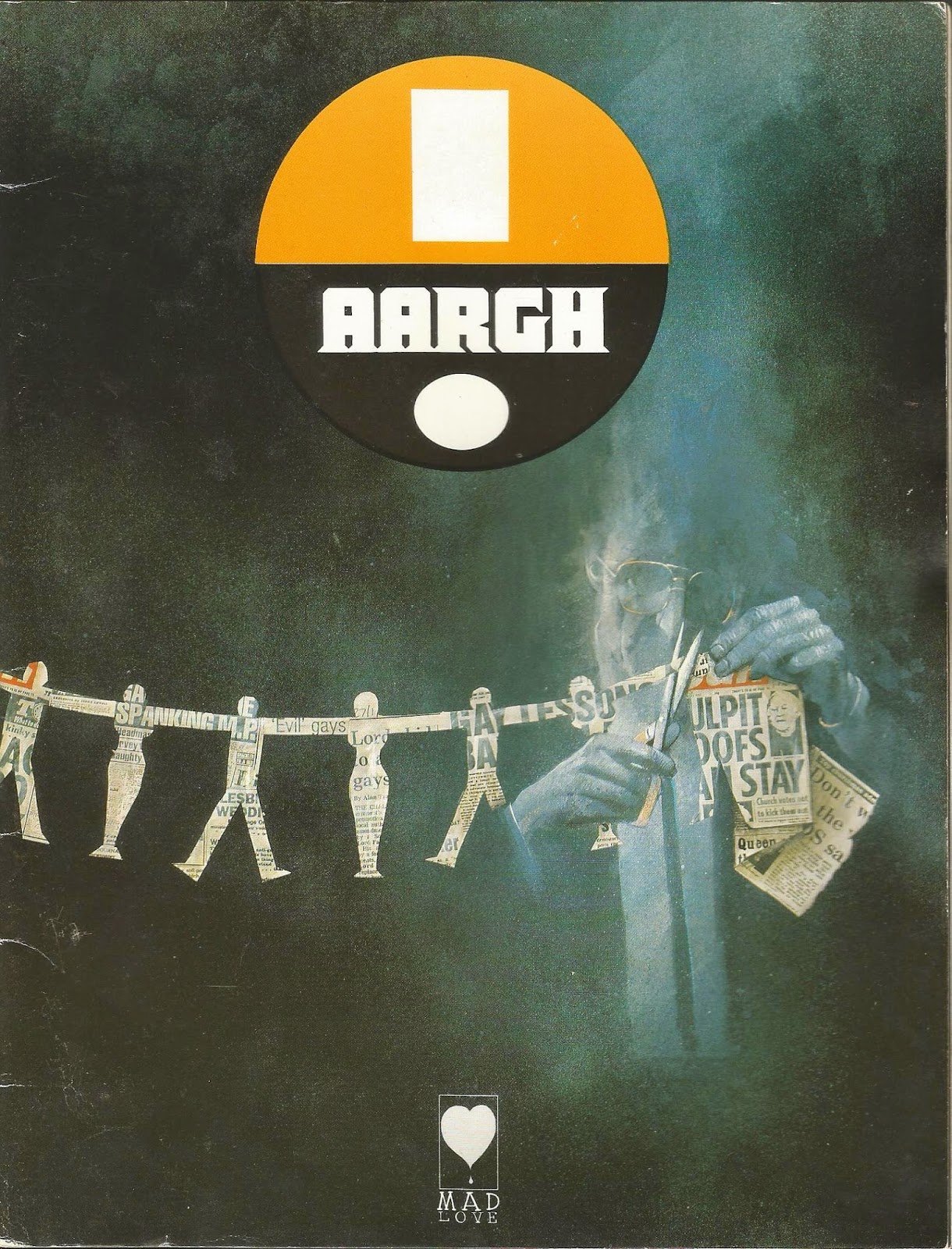
Alan Moore Obscurities: AARGH - Artists Against Rampant Government Homophobia

"My love.  The vain, malignant hordes are with us still" - Narrator ("The Mirror Of Love")

My intial plan for this blog was to review an Alan Moore Obscurity at the beginning of every month.  But I feel this is a little different from Alan Moore's usual work and so I'm dropping it in now.  The reason it's different is that this is an anthology comic of which Moore writes only the first strip, the rest being contributed by the cream of late 80's comic book artists and writers.  It was also one of the few things self published by Moore's ill-fated own publishing company - Mad Love.  This is in in fact a charity comic protesting a 1988 piece of UK Goverment Legislation known as Clause or Section 28.  This ill-defined act declared it illegal for Local Governments who "shall not intentionally promote homosexuality or publish material with the intention of promoting homosexuality" or "promote the teaching in any maintained school of the acceptability of homosexuality as apretended family relationship".  I fully recommend you read the Wikipedia article on the history of the bill, which wasn't repealed until 2003 by the Labour party who had always opposed it, despite fierce opposition from many Conservative polititicians whose party had enacted it. 

If you just want the highlights there are a couple of things to note.  First, being gay in 1980's Britain wasn't a barrel of laughs. Blamed for the AIDS epidemic, gay men tended to be identified as indulging in a bestial perversion punishable by God's wrath, an attitude that drove much of the impetus behind Section 28 and that was still showing up in the popular press well into the noughties.  Lesbians suffered less outright hatred, but tended to be lumped in with the most extreme forms of feminism and were mainly laughed at, or considered ugly man haters who just needed a good man to bang some sense into them.  As wikipedia points out:

Wikipedia: "Rising negative sentiments towards homosexuality eventually peaked in 1987, the year before the legislation was enacted. According to the British Social Attitudes Survey, 75% of the then population held homosexual activity to be 'always or mostly wrong', with just 11% believing it to be never wrong. As of 2012, those figures stand at 28% and 47% respectively."
Just Waiting by Dave Gibbons
On the upside, social attitudes started to change quite quickly, but on the downside, we got things like Clause 28, brought about because while Conservatives ruled nationally,  many local governments were run by the left and liberal wings of British politics, and the impetus for the Bill was bought about by an innocuous American book about a girl with two dads.  Although there was never any proof this made it into any school, it was seen as part of an agenda to inculcate the young into the twilight world of the homosexual by "loony" left-wing councils.  In practice, it simply made things a lot harder for teachers to, say deal with the homophobic bullying of teenagers in their care (my sister, who started teaching in 1999 confirmed this).  No successful prosecutions were ever bought under the act but it remained a powerful totem of intolerance on the statute books.  Oh and because I am feeling unfair about this, want to know what our current fuhrer David cameron thought about Section 28?

Wikipedia: "In 2000, David Cameron (at that time an unelected Conservative party member) repeatedly attacked the Labour government's plans to abolish Section 28, publicly criticising then-Prime Minister Tony Blair as being "anti-family" and accused him of wanting the "promotion of homosexuality in schools". In 2003, once Cameron had been elected as Conservative MP for Witney, he continued to support Section 28. As the Labour government were determined to remove Section 28 from law, Cameron voted in favour of a Conservative amendment that retained certain aspects of the clause, which gay rights campaigners described as "Section 28 by the back door". This was unsuccessful, and Section 28 was repealed by the Labour government without concession."
Clause For Concern by Kevin O'Neil
To be fair he has since apologised, and his government did end up equalising gay marriage, so I just about forgive him.  But it's instructive to see how long this Bill lingered into the 21st century long past the widespread acceptance of gay people into wider society and what kind of people were still championing it even then.

I have to say, reading about how high homophobic sentiment was in the late 80's makes me even more impressed that Fleetway, the publishers of Crisis allowed a comic depiction of an out gay relationship in The New Statesmen, which I covered last month.  Alan Moore decided he was going to uses his newfound, post-Watchmen clout in the industry to publish a comic that would raise awareness and raise money to oppose the bill (it raised at least £17,000 in the end that was passed onto a gay charity).  Moore wasn't opposed to the bill just because he is a decent guy; at that time he was living in a polyamorous relationship with his wife and their mutal, female lover. So he was part of a family directly targeted by the bill.  This experimental relationship didn't last, as his wife and their lover ran off together and set up home without him.  Moore being the classy guy he is still continued to write postitive depictions of gay characters into his subsequent work.
Real Dream by Art Speigelman
Contributing to ARRGH were the likes of included Robert Crumb, Howard Cruse, Hunt Emerson, Neil Gaiman, Dave Gibbons, Los Bros Hernandez, Garry Leach, Dave McKean, Frank Miller, Harvey Pekar, Savage Pencil, Bill Sienkiewicz, Keven O'Neil, Brian Bolland, Dave Sim, Posy Simmonds, Art Spiegelman, and Bryan Talbot.  Moore contributed the lead eight-page story called "The Mirror Of Love" which was illustrated by Rick Vietch and Steve Bissette.  Because many of the contributions were single page strips I am going to focus more on discussing the story-led multiple page strips, but I've include a few single-pagers as well for you to enjoy on their own merits.

I didn't buy this comic during the time it was first out.  I was 14 in 1988, and although I knew I wasn't straight, I wasn't gay either then, having as I did a very misanthropic attitude towards the whole human race.  When it finally clicked that I was gay in 1993, being gay was already being seen as less of a tragic burden and more a legitmate part of one's identity.  Having the good fortune to have liberal parents who didn't care and going to University in a city which had a large gay "village", I never have experienced direct homophobia in my life, for which I am very grateful.  Anyway, enough with the background, lets look at some of the strips.
The Mirror Of Love by Alan Moore, Steve Bissette and Rick Veitch
The book leads with Moore's "The Mirror of Love" a lyrical journey through the history of homosexuality in society, its ups and downs.  Beautifully illustrated by Steve Bissette and Rick Veitch who he had worked with on Swamp Thing.  It takes in early matriarchal societies, the anti-gay rethoric of Leviticus, the ancient Greek's and Spartans,  Sappho, more potshots at Christianity:

Narrator: "Yet this tolerance could not endure the rise of Christianity, which quite ignored Christ's love for outlaws and instead embraced moral severity. Defining sex as base. St. Paul named same-sex love, for the first time, as a sin ."

The journey then continues through the executions of gay people during the dark ages, the smearing of the Knight's Templar as gay, themore liberal societies bought about by the Renaissance and the famous gay/bisexual artists it laid claim to.   Further on it places the first link between homosexuality and the theatre to Shakespeares time,  he also tells us a bout a lesbian community at Llangollen, then on through qwriters and dramatists placing coded words to same-sex lovers through the ages. 

Narrator: "Elseqwhere in Leipzig, 1869, One K.M. Benkert first referred to 'homosexuality'. Industrial Englands view that all must be explained by science prompted dotors to declare us ill.  Not friends or sinners anymore."

Then we travel through Oscar Wilde's trial and disgrace to nascent homosexual pride movements, but then WW2 breaks out and homosexual are placed in concentration camps.  But post-war the push for homosexual equality gathers pace.  The Uk decriminalises it, while gays in the US riot at Stonewwall.  Just as it seems a more tolerant soceity is in sight, AID's arrives.

Narrator: "Policemen claimed to speak for God, describing persons with AIDs as swilling in a self-made cesspit, while councillor Brownhills, a conservative, recalled an earlier Final Solution, and offered to 'gas the queers'.  Margaret Thatcher praised them for their forthrightness."

Those are not made up quotes.  The Chief Constable of Manchester, James Anderton was the anti-gay policeman who made the "cess-pit" remark and made life hard for the growing gay community in that city for years.  The story ends with Clause 28 being passed into law.

Narrator: "While life endures we'll love. And afterwards, if what they say is true, I'll be refused a heaven crammed with Pope's, policemen and fundamentalists, and burn instead, quite happily with Sappho, Michelangelo and you my love.  I'd burn through eternity with you."
The Mirror Of Love by Alan Moore, Steve Bissette and Rick Veitch
If it seems a little unfair that Moore is taking so many shots at Christianity here, it's a sad fact of life that the fundamentalist right-wing Christian movement, emboldened by the conservatism of Thatcher sought ways to influence public life further and I'm afraid Clause 28 was one of those things they whole-heartedly supported.  Of course, there must have been plenty of liberal Christians horrified at what was being done in the name of their religion and I know many prominent Christians spoke out against the Clause and a few years later at University, I ended up with some Christian friends who were totally cool about gay issues.  But at this point in time, the gay community and fundamentalist Christians were "enemies" and Moore is only reflecting upon that.
From Homogeonous To Honey by Neil Gaimen, Bryan Talbot and Mark Buckingham
Neil Gaiman had formed a close friendship with Moore in the mid 80's.  He'd enjoyed a pretty fast rise to fame in the comic's world, working for 2000AD and taking over from Moore on Marvelman/Miracleman.  His contribution to AARGH comes roundabout the same time he was hired by DC to do his most famous comic work The Sandman.  He takes a slightly different tack from Moore in his strip here. At the time of the Clause's vote into law, there were people in local government who saw it as a way to retroactively erase all homosexual influence from public life and culture.  Gaiman takes a satirical look at how this translate in practice, all trace of difference and "perversity" gone from history would make for a very bland and homogenous life now in a strip drawn by Bryan Talbot and Mark Buckingham.

Masked Man:  "Today the world is a simpler place.  We've taken out all the complications.  All the square pegs and the painful and the strange.  In Utopia, lacking cultural relevant for deviancy all are happy with their lot.  Everybody is exactly the same.  Isn't it sweet?"
From Homogeonous To Honey by Neil Gaiman, Bryan Talbot and Mark Buckingham
Of course Gaiman is using extreme exaggeration to make his case, but it must be remembered that this was countering the extremisim on the other side as it were, people who quite openly said they wanted gays herded into gas chambers to prevent the spread of AIDs and who saw lesbian mothers as unfit to raise their children amongst other things.

Dave Sim's contribution uses characters from his long running Cerebus series, which I covered extensively when I kicked this blog off.  It was a comic about an Aardvark who lived in a parody of Conan the Barbarian's world, before spinning off into a satire of politics and religion.  Cerebus himself doesn't appear in this strip, instead we get the Wolveroach and his two sidekicks.  The Roach was a character who shifted identities all the time, lampooning one popular super-hero character after another.  What's an interesting little joke about using his character was that Dave Sim dropped little hints now and then in early arcs that at least one of his split-personalities was gay. 
An Untold Tale Of The Super Secret Sacred Wars by Dave Sim
The Roach then strikes me exactly as the kind of character, with his buttoned up sexuality to be fascinated with exposing gay activity while having gay thoughts himself. Sadly, while this strip is dedicated with love to Moore's wife and girlfriend (who he later openly insulted in one of the 90's Cerebus books, tsk tsk), Sim would undergo a quite radical shift in opinion and by his last book in the Cerebus series was including homophobic diatribes in his work equating homosexuality with paedophilia and other such nonsense.  I'm not sure if his friendship with Moore survived that, but at least here I get to enjoy some extra Sim artwork from one of the best run's in the series (Church & State).
An Untold Tale Of The Super Secret Sacred Wars by Dave Sim
Frank Miller might seem like a surprising inclusion, given his politics now.  His rant about Occupy Wall Street being a bunch of rapists and theives and most notoriously, his virulently Islamophobic book Holy Terror all combine to give the impression he's something of a right wing nutcase.  And even Alan Moore himself called him an idiot for his comments on the Occupy movement.  But back in the 80's he and Alan Moore had a lot in common.  Both wrote books that redefined the comicbook genre; and indeed Moore himself wrote the introduction to The Dark Knight Returns.  They both fell out with DC over issues regarding a ratings system for comics and both went on to have critically acclaimed success in creator owned comicbooks, Sin City and 300 for Miller; From Hell and Lost Girls for Moore. 
The Future of Law Enforcement by Frank Miller
And what people tend to forget is The Dark Knight Returns is a coruscating attack on Reaganite America, he was by no means a right-wing nutcase back then in his writing at least.  His contribution is the amusing tale of a boorish, queerbashing heterosexual, who after an accident is rendered a paraplegic attracted to men (hilariously, he is rendered gay by an accident where his car is "rear ended!").  So he allows himself to be rebuilt as "Robohomophobe" playing off the then popular film hit Robocop.  Miller wrote and drew his contribution and it's very recognisable as his work, great charicature of Thatcher as well. Nice one Frank.
The Future of Law Enforcement by Frank Miller
AARGH is a great compilation of politically savage comic strips, which was assembled for a good cause and functions as a brilliant snap-shot of Who was Who in the UK comic's world in 1988. There's plenty more stuff in the collection, but I decided to focus mainly on those still well known today.  The coup of getting international contributions from the likes of Art Speigelman (Maus), the Hernandez Brothers (Love and Rockets) and Frank Miller shouldn't be underestimated either and really shows how powerful and influential post-Watchmen era Alan Moore was.  If there were any postives to come out of the Clause 28 debacle, it was that it radicalised the UK LGBT community in the same way the Stonewall riots had done for the US community in the late 60's.  If you want to see an awesome example of anti-Clause 28 protest in action, follow this link to a Youtube clip of a gang of lesbians invading the live BBC 6 o'clock news broadcast!
Back cover by Los Bros Hernandez
As society and acceptance moved on, Clause 28 became something of an embarressment.  An outdated relic that many conservatives wished to do away with as Labour and the Liberals did (though we musn't forget some on the left did support the Clause as well).  In the much more tolerant society we live in today, it seems hard to credit that such a deliberately homophobic piece of legislation was ever passed into law.  But thankfully we live in more enlightened times now, and while homophobia in public life hasn't completely vanished (thanks to the likes of UKIP and the BNP) the chances of such anti-gay policies being enacted today are practically zero, and for that we can be truly thankful.

Saturday, 9 August 2014

JLA: Earth 2

 "What have I done..? Why do I always fail?" - Luthor

Let's talk about the DC comics multiverse.  Before 1985 there existed in DC's continuity a multitude of parallel Earths that had grown up to explain discrepencies between storylines as well as incorporate things that DC didn't want in their regular continuity.  These multiple Earths had numbers, the main DCverse being Earth 1 which had the current set of heroes and stories taking place.  Earth 2 which had the original Golden Age heroes living on it and who had been allowed to grow older and form relationships, for example Superman and Lois Lane were married on this Earth as were Batman and Catwoman.  Earth 3 had villainous versions of our heroes, instead of the Justice League there was the Crime Syndicate of America.  Other Earth's formed the home of characters DC had bought from other companies, so Earth 4, for example, was the home of the Charlton comics heroes. Earth-S, the home of the Fawcett Captain Marvel characters.  And so on.  By the early 80's it was felt this multiverse had become confusing both to readers and to the comic creators themselves.  A huge event series then took place called Crisis Of Infinite Earths that finished with only one Earth left with various heroes either gone completely or retconned into the single Earth's new history.

Grant Morrison - the writer of this graphic novel - was not a fan of this reductionism. As he wrote in his book Supergods:

"There were complaints that the parallel-worlds system was too hard to understand, when if fact it was systematic, logical, and incredibly easy to navigate, particularly for young minds that were made for this kind of categorisation of facts and figures"

 He first took potshots at Crisis On Infinite Earth's in his acclaimed run on Animal Man, the titular hero actually met many of the heroes who had been erased from existence (before meeting Morrison himself, it was very meta).  When Morrison was put in charge of the new Justice League of America reboot in the late 90's he decided he wanted to use the idea of the evil JLA again, but as Earth 3 no longer existed he was forced to get creative.  And so JLA: Earth 2 deals with an "anti-matter" opposite universe that coincidentally has all the characters from Earth 3 living on it, including the Crime Syndicate of Amerika (spelt deliberately with a "k") a gang of super-villains opposed only by the saintly Lex Luthor.
Superwoman, Ultraman, Owlman, Power Ring and Johnny Quick
Morrison had fought hard to get the classic line-up of the JLA back into the book, it consisted of Superman, Batman, Wonder Woman, Green Lantern, Flash, Martian Manhunter and Aquaman.  The Crime Syndicate had versions of all of them bar Martian Manhunter and Aquaman. Hopefully the JLA need no introduction but you might not be familiar with the Crime Syndicate so their here's a quick guide to them.

Ultraman is Superman's counterpart.  Instead of the benevolent alien who came to Earth as a child, Ultraman is a human astronaught - Clark Kent - who was given "Anti-Kryptonite" powers by aliens and depends upon it for his powers.  He is a tyrant and a murderer and watches over Earth from the CSA base in Earth orbit, frying dissenters with his heat vision.  Batman's counterpart is Owlman, Thomas Wayne Jr. who was Bruce Waynes older brother in several different continuities.  He enchanced his intellect with a drug and carries on an affair with Supwerwoman, who is Wonder Woman's counterpart, Lois Lane!  She is an Amazon who killed all the other Amazons then took the name Lois Lane, her lasso releases people inhibitions.  Green Lantern is represented by Power Ring, instead of being an human who was granted his ring by an alien police force, Power Ring gained his ring from a being called Volthoom, who still exists in the ring and makes inane observations all the time.  Finally there is the Flash's counterpart, Johnny Quick who instead of being natrually fast like the Flash, has to use a drug called "Speed Juice" to reach hyper-speeds.

Before I begin, I have to fangirl a little about the Frank Quitely's art. This year 2000 project is an early collaboration of him and Morrison, the pair going on to work on the likes of the critically acclaimed All-Star Superman, We3, The New X-men and Batman.  His fine detailed line-work and solid understanding of anatomy, layouts and action scenes, especially when coupled with a great colourist, make his art downright gorgeous to look at as it is here.  I definitely rank his as one of the greatest comicbook artists working in the industry right now.  Anyway, with that said, lets look at JLA Earth 2 proper.
The good Luthor
The story begins with Ultraman, Superwoman and Owlman discussing the escape of "him".  Back on the normal Earth, Luthor appears out of thin air to a shocked pair of people.

Luthor: "I've just reversed across the matter/antimatter membrane and this is my reception?   I am Luthor.  Now.. where can I find the super-people around here?"

The action cuts to the JLA dealing qwith a crashing, fragmented aeroplane. When they bring the pieces back down to Earth they make an eerie discovery.  Benedict Arnold is on their money, not George Washington (I think the joke here is that Arnold is considered one of the very worst US presidents in the normal world), their hearts are on the right side of their chests and the markings on the plane are not anything that they recognise.
The JLA drop by for a chat.
At Lex Corp building, the new Lex Luthor has locked up this worlds one and decides to divert cash from the armaments devision to Greenpeace and gives all employees a 20% raise.  Superman, Wonder Woman, Green Lantern and Martian Manhunter appear at the office window.  Martian Manhunter notes his unsual DNA and locked off thoughts.  Luthor reveals that he comes from a anti-matter universe and accepts their invitation to come to JLA headquarters.

On the anti-matter Earth, Ultraman has dropped tonnes of fake money onto the city to ruin the economy.  His slave Braniac says they have only had partial success in tracing Luthor's exhaust fumes.  Down below, a man loses his rag:

Man: "..Not real! It's crap! It's just more crap from the sky! From Ultraman!  I can't take anymore of this!  I can't take anymore of them looking down at us as though we're --"

And Ultraman fries him into a steaming puddle with his heat vision.
Don't piss off Ultraman
Braniac tells Ultraman he has verified the existence of a matter universe, the matter cannon that Lex used allowed for matter and anti-matter to be able to coexist.  Ultraman calles a meeting of the Crime Syndicate.

On the JLA moonbase, Luthor fills them in on the background of the CSA, he wants their help defeating them and bringing and end to their tyranny.

Batman: "I say no. I'm sorry but this world has it's own troubles. We're not some kind of inter-dimensional police force."

Luthor pleads that they give him 48 hours to change everything.  The JLA dicuss it and decide to help, with Martian Manhunter and Aquaman staying behind to look after their Earth.  In Luthor's spaceship he says he settled on the name "Earth 2" for the JLA's world then they cross the dimensional barrier to the anti-matter universe.
Owlman and Superwoman play a dangerous game
On the anti-matter Earth, a policeman is trying to apprehend Owlman, saying he doesn't work with him or "Boss Gordon".  Owlman blasts his way out and is picked up by Superwoman.  They share a kiss on top of a building then go on to the CSA headquarters.

At the meeting of the CSA they discuss the implications of Luthor's disappearence and the existence of a matter universe.  Ultraman sees it as another world to conquer and they raise their glasses to it.  After the meeting, Ultraman (qwho sees Superwoman as his) warns Owlman:

Ultraman:
"One of these days you'll go too far, Owlman.  And you wont come back"

Owlman:
"Sure. Until then, I have the negatives remember?"

Ultraman: "One day."
A meeting of the CSA
Back with the JLA, they are incognito in the city, dismayed at it's grimmness and the viciousness of the people.  Batman goes to the police station and talks with the man who qwas trying to arrest Owlman earlier.  He turns out to be Thomas Wayne senior, in this reality his wife and Bruce died, placing him and Thomas Wayne Junior - Owlman- at odds.  Batman tells him to be ready for the cessation of the rule of the CSA.  Back wqith Wonder WQoman, Batman confides some fears he has:

Batman: "If this world and the Crime Syndicate's are opposites in every way... How will what we do here be reflected back home?"

Superman says he has never seen such misery and hatred that lives here.  Now Green Lantern creates a huge pair of hands and clasps them round the CSA's moonbase.  Trapping all bar Superwoman, who is currently in a store room in the Daily Planet, tormenting Jimmy Olsen.  She flies to the flying fortress and is confronted by Luthor and the JLA.  Wonder Woman knocks her out and they use the teleporter to send her to the main CSA base and have her trapped as well.  Wonder Woman then makes a global broadcast:

Green Lantern traps the CSA
Wonder Woman: "We've learned that yours is a world crushed by tyranny, paralysed by crime.  Crippled by corruption to the highest level. We've heard the call and the Super Syndicate is no more. Look up again.  The skies are safe and we're here to set you free."

The JLA set about improving things, including feeding the starving populace of a war ravaged Britain who have never recovered from being beaten in 1776 when they tried to gain independence from the USA.

Batman helps Thomas Wayne Snr. clear out the corrupt cops and they arrest Boss Gordon who they had cornered in City Hall.
The villianess Boss Gordon is arrested by Thomas Wayne Snr.
Thomas Wayne: "I'm putting a wall round this city; making it  self sufficient, strong and clean. And anyone who doesn't like it gets a bullet in the face."

Back on the CSA base, Owlman tells them there is no need to try and escape, the scales will balance.  And as he says that, they all shift dimensions to the JLA's matter Earth.  Luthor confirms it, and the JLA tell him they'll have to leave and go deal with them as the CSA starts to run riot on their world.

Ultraman: "There is justice after all.  A whole new world stretched out and screaming.  Start with terror.  Always soften them up with fear."
Martain Manhunter beats down Ultraman
Aquaman and Martian Manhunter arrive on the scene.  Aquaman takes down Power Ring while Martian Manhunter defeats Ultraman.  He's is weakened because the anti-kryptonite that is the source of his power is in another dimension.  Superwoman flirts with Martian Manhunter, but he smacks her down.  Owlman is kneeling by the grave of Thomas and Martha Wayne.  He tells Johnny Quick to deliver a message to the others:

Owlman: "Tell them we've been duped.  We've been sent to the one place we can't succeed either.  Tell them nothing means anything.  He's dead.  There's no one left to hurt."


Back in the anti-matter Earth, Flash is using his speed energy to power up the reversal engine so they can get back.  He and Luthor realise the aeroplane switch might have been someone testing the technology in secret.  Not Ultraman as he doesn't understand how the cyclotron works.  Luthor suddenly realise that only leaves Brainiac, as Brainiac informs him this is the case.

Brainiac wanted the CSA neutralised to end his slavery.  He transmits himself into every circuit in the Flying Fortress.  He has softened the membrane betqween the two worlds and aims to collide the pair of them.  On the surface of the anti-matter world Batman says they must stop trying to change things, that they have been played.

Wonder Woman: "We failed them. We failed Luthor."

Batman: "Only because our methods can't succeed on this world.  It's a law of nature.  Everything we do is ordained to fail.  Even good deeds go bad here."
The twqo Earth's on a collisions course
On the Flying Fortress Luthor asks Brainiac why he is doing this.  Brainiac want's to create a massive amount of energy converting everyone on both worlds into it when he crashes the two Earths into each other.  Superman goes to attack Brainiac, but realises he can't kill him when he discovers Brainiac is part organic.

Brainiac: "I am monitoring all your efforts to prevent my upgrade.  The equation is simple.  Here 'evil' wins."

Superman agrees, but says Brainiacs plan didn't account for the JLA doing something deliberately "bad", like walking away in a time of crisis.  They can't defeat Brainiac but they know someone who can, and with a final burst of speed energy from the Flash, the JLA and CSA swap places, and Ultraman has no compunctions about disabling Brainiac.
Ultraman takes out Brainiac
The JLA watch as the anti-matter Earth phases back into it's own universe.  They start repairing the damage done to Washington and ponder Luthor's fate.  One man, always doomed to fail.  Batman wonders if contact with their other selves has changed the CSA at all.

It seems not.  The CSA are back taking bribes from the President, they've obliterated London and Gotham is now a police state.   Superwoman and Owlman ponder their other selves.

Superwoman: "I keep thing about them.  Why do they do it?  What do they get? I don't understand what..."

Owlman: "I keep thinking about you.  He can't always be watching."

They kiss, and a bolt of Ultraman's heat visions lances down, killing a cat that was in the tree above. "Missed" grins Owlman.  The book ends with Ultraman aboard the Flying Fortress, watching over the world always.
Ultraman is watching you
JLA Earth 2 is a hugely enjoyable book.  It's always great seeing the classic League line-up in action and having the CSA come from an anti-matter world rather than a parallel world was a very creative way of getting around the lack of a multiverse in DC at the time.  It also plays up the "everything is opposite" angle better than if it was just another parallel world.  Winning by doing nothing feels like an element of Grant Morrison's spirituality creeping into the narrative, but it works well, so no complaints there (It's also reminiscent of the solution to the plot of the 1980 Doctor Who serial Warrior's Gate, Grant being a huge nerd about these things and a "out" Doctor Who fan, might have been influenced by it without realising). The dark mirror that our heroes have to deal with is compelling and it's interesting to note that Owlman, like his good counterpart is the one that points out the futility of their actions and seems to be the most clued into what's going on. 

Interestingly, the CSA here, who all pretty much hate each other, strongly remind me of the spoof JLA of Garth Ennis's misantrhopic super-hero series, The Boys.  I'd be curious to knoqw if this comic qwas an influence or if it's just a coincidence they both give off the same vibe. I can't praise Frank Quitely's art highly enough, drawing definite versions of all the charaters. DC comics has actually gone back to a limited version of the multiverse that came about with it's 2011 "New 52" relaunch.  The Crime Syndicate of America are back as the Earth 3 counterparts of The Justice League, with all five members shown here, plus a few new faces.  I think for many people though, the depiction of them in JLA Earth 2 will remain the definitive one for a long time to come.