Saturday, 9 August 2014

JLA: Earth 2

 "What have I done..? Why do I always fail?" - Luthor

Let's talk about the DC comics multiverse.  Before 1985 there existed in DC's continuity a multitude of parallel Earths that had grown up to explain discrepencies between storylines as well as incorporate things that DC didn't want in their regular continuity.  These multiple Earths had numbers, the main DCverse being Earth 1 which had the current set of heroes and stories taking place.  Earth 2 which had the original Golden Age heroes living on it and who had been allowed to grow older and form relationships, for example Superman and Lois Lane were married on this Earth as were Batman and Catwoman.  Earth 3 had villainous versions of our heroes, instead of the Justice League there was the Crime Syndicate of America.  Other Earth's formed the home of characters DC had bought from other companies, so Earth 4, for example, was the home of the Charlton comics heroes. Earth-S, the home of the Fawcett Captain Marvel characters.  And so on.  By the early 80's it was felt this multiverse had become confusing both to readers and to the comic creators themselves.  A huge event series then took place called Crisis Of Infinite Earths that finished with only one Earth left with various heroes either gone completely or retconned into the single Earth's new history.

Grant Morrison - the writer of this graphic novel - was not a fan of this reductionism. As he wrote in his book Supergods:

"There were complaints that the parallel-worlds system was too hard to understand, when if fact it was systematic, logical, and incredibly easy to navigate, particularly for young minds that were made for this kind of categorisation of facts and figures"

 He first took potshots at Crisis On Infinite Earth's in his acclaimed run on Animal Man, the titular hero actually met many of the heroes who had been erased from existence (before meeting Morrison himself, it was very meta).  When Morrison was put in charge of the new Justice League of America reboot in the late 90's he decided he wanted to use the idea of the evil JLA again, but as Earth 3 no longer existed he was forced to get creative.  And so JLA: Earth 2 deals with an "anti-matter" opposite universe that coincidentally has all the characters from Earth 3 living on it, including the Crime Syndicate of Amerika (spelt deliberately with a "k") a gang of super-villains opposed only by the saintly Lex Luthor.
Superwoman, Ultraman, Owlman, Power Ring and Johnny Quick
Morrison had fought hard to get the classic line-up of the JLA back into the book, it consisted of Superman, Batman, Wonder Woman, Green Lantern, Flash, Martian Manhunter and Aquaman.  The Crime Syndicate had versions of all of them bar Martian Manhunter and Aquaman. Hopefully the JLA need no introduction but you might not be familiar with the Crime Syndicate so their here's a quick guide to them.

Ultraman is Superman's counterpart.  Instead of the benevolent alien who came to Earth as a child, Ultraman is a human astronaught - Clark Kent - who was given "Anti-Kryptonite" powers by aliens and depends upon it for his powers.  He is a tyrant and a murderer and watches over Earth from the CSA base in Earth orbit, frying dissenters with his heat vision.  Batman's counterpart is Owlman, Thomas Wayne Jr. who was Bruce Waynes older brother in several different continuities.  He enchanced his intellect with a drug and carries on an affair with Supwerwoman, who is Wonder Woman's counterpart, Lois Lane!  She is an Amazon who killed all the other Amazons then took the name Lois Lane, her lasso releases people inhibitions.  Green Lantern is represented by Power Ring, instead of being an human who was granted his ring by an alien police force, Power Ring gained his ring from a being called Volthoom, who still exists in the ring and makes inane observations all the time.  Finally there is the Flash's counterpart, Johnny Quick who instead of being natrually fast like the Flash, has to use a drug called "Speed Juice" to reach hyper-speeds.

Before I begin, I have to fangirl a little about the Frank Quitely's art. This year 2000 project is an early collaboration of him and Morrison, the pair going on to work on the likes of the critically acclaimed All-Star Superman, We3, The New X-men and Batman.  His fine detailed line-work and solid understanding of anatomy, layouts and action scenes, especially when coupled with a great colourist, make his art downright gorgeous to look at as it is here.  I definitely rank his as one of the greatest comicbook artists working in the industry right now.  Anyway, with that said, lets look at JLA Earth 2 proper.
The good Luthor
The story begins with Ultraman, Superwoman and Owlman discussing the escape of "him".  Back on the normal Earth, Luthor appears out of thin air to a shocked pair of people.

Luthor: "I've just reversed across the matter/antimatter membrane and this is my reception?   I am Luthor.  Now.. where can I find the super-people around here?"

The action cuts to the JLA dealing qwith a crashing, fragmented aeroplane. When they bring the pieces back down to Earth they make an eerie discovery.  Benedict Arnold is on their money, not George Washington (I think the joke here is that Arnold is considered one of the very worst US presidents in the normal world), their hearts are on the right side of their chests and the markings on the plane are not anything that they recognise.
The JLA drop by for a chat.
At Lex Corp building, the new Lex Luthor has locked up this worlds one and decides to divert cash from the armaments devision to Greenpeace and gives all employees a 20% raise.  Superman, Wonder Woman, Green Lantern and Martian Manhunter appear at the office window.  Martian Manhunter notes his unsual DNA and locked off thoughts.  Luthor reveals that he comes from a anti-matter universe and accepts their invitation to come to JLA headquarters.

On the anti-matter Earth, Ultraman has dropped tonnes of fake money onto the city to ruin the economy.  His slave Braniac says they have only had partial success in tracing Luthor's exhaust fumes.  Down below, a man loses his rag:

Man: "..Not real! It's crap! It's just more crap from the sky! From Ultraman!  I can't take anymore of this!  I can't take anymore of them looking down at us as though we're --"

And Ultraman fries him into a steaming puddle with his heat vision.
Don't piss off Ultraman
Braniac tells Ultraman he has verified the existence of a matter universe, the matter cannon that Lex used allowed for matter and anti-matter to be able to coexist.  Ultraman calles a meeting of the Crime Syndicate.

On the JLA moonbase, Luthor fills them in on the background of the CSA, he wants their help defeating them and bringing and end to their tyranny.

Batman: "I say no. I'm sorry but this world has it's own troubles. We're not some kind of inter-dimensional police force."

Luthor pleads that they give him 48 hours to change everything.  The JLA dicuss it and decide to help, with Martian Manhunter and Aquaman staying behind to look after their Earth.  In Luthor's spaceship he says he settled on the name "Earth 2" for the JLA's world then they cross the dimensional barrier to the anti-matter universe.
Owlman and Superwoman play a dangerous game
On the anti-matter Earth, a policeman is trying to apprehend Owlman, saying he doesn't work with him or "Boss Gordon".  Owlman blasts his way out and is picked up by Superwoman.  They share a kiss on top of a building then go on to the CSA headquarters.

At the meeting of the CSA they discuss the implications of Luthor's disappearence and the existence of a matter universe.  Ultraman sees it as another world to conquer and they raise their glasses to it.  After the meeting, Ultraman (qwho sees Superwoman as his) warns Owlman:

Ultraman:
"One of these days you'll go too far, Owlman.  And you wont come back"

Owlman:
"Sure. Until then, I have the negatives remember?"

Ultraman: "One day."
A meeting of the CSA
Back with the JLA, they are incognito in the city, dismayed at it's grimmness and the viciousness of the people.  Batman goes to the police station and talks with the man who qwas trying to arrest Owlman earlier.  He turns out to be Thomas Wayne senior, in this reality his wife and Bruce died, placing him and Thomas Wayne Junior - Owlman- at odds.  Batman tells him to be ready for the cessation of the rule of the CSA.  Back wqith Wonder WQoman, Batman confides some fears he has:

Batman: "If this world and the Crime Syndicate's are opposites in every way... How will what we do here be reflected back home?"

Superman says he has never seen such misery and hatred that lives here.  Now Green Lantern creates a huge pair of hands and clasps them round the CSA's moonbase.  Trapping all bar Superwoman, who is currently in a store room in the Daily Planet, tormenting Jimmy Olsen.  She flies to the flying fortress and is confronted by Luthor and the JLA.  Wonder Woman knocks her out and they use the teleporter to send her to the main CSA base and have her trapped as well.  Wonder Woman then makes a global broadcast:

Green Lantern traps the CSA
Wonder Woman: "We've learned that yours is a world crushed by tyranny, paralysed by crime.  Crippled by corruption to the highest level. We've heard the call and the Super Syndicate is no more. Look up again.  The skies are safe and we're here to set you free."

The JLA set about improving things, including feeding the starving populace of a war ravaged Britain who have never recovered from being beaten in 1776 when they tried to gain independence from the USA.

Batman helps Thomas Wayne Snr. clear out the corrupt cops and they arrest Boss Gordon who they had cornered in City Hall.
The villianess Boss Gordon is arrested by Thomas Wayne Snr.
Thomas Wayne: "I'm putting a wall round this city; making it  self sufficient, strong and clean. And anyone who doesn't like it gets a bullet in the face."

Back on the CSA base, Owlman tells them there is no need to try and escape, the scales will balance.  And as he says that, they all shift dimensions to the JLA's matter Earth.  Luthor confirms it, and the JLA tell him they'll have to leave and go deal with them as the CSA starts to run riot on their world.

Ultraman: "There is justice after all.  A whole new world stretched out and screaming.  Start with terror.  Always soften them up with fear."
Martain Manhunter beats down Ultraman
Aquaman and Martian Manhunter arrive on the scene.  Aquaman takes down Power Ring while Martian Manhunter defeats Ultraman.  He's is weakened because the anti-kryptonite that is the source of his power is in another dimension.  Superwoman flirts with Martian Manhunter, but he smacks her down.  Owlman is kneeling by the grave of Thomas and Martha Wayne.  He tells Johnny Quick to deliver a message to the others:

Owlman: "Tell them we've been duped.  We've been sent to the one place we can't succeed either.  Tell them nothing means anything.  He's dead.  There's no one left to hurt."


Back in the anti-matter Earth, Flash is using his speed energy to power up the reversal engine so they can get back.  He and Luthor realise the aeroplane switch might have been someone testing the technology in secret.  Not Ultraman as he doesn't understand how the cyclotron works.  Luthor suddenly realise that only leaves Brainiac, as Brainiac informs him this is the case.

Brainiac wanted the CSA neutralised to end his slavery.  He transmits himself into every circuit in the Flying Fortress.  He has softened the membrane betqween the two worlds and aims to collide the pair of them.  On the surface of the anti-matter world Batman says they must stop trying to change things, that they have been played.

Wonder Woman: "We failed them. We failed Luthor."

Batman: "Only because our methods can't succeed on this world.  It's a law of nature.  Everything we do is ordained to fail.  Even good deeds go bad here."
The twqo Earth's on a collisions course
On the Flying Fortress Luthor asks Brainiac why he is doing this.  Brainiac want's to create a massive amount of energy converting everyone on both worlds into it when he crashes the two Earths into each other.  Superman goes to attack Brainiac, but realises he can't kill him when he discovers Brainiac is part organic.

Brainiac: "I am monitoring all your efforts to prevent my upgrade.  The equation is simple.  Here 'evil' wins."

Superman agrees, but says Brainiacs plan didn't account for the JLA doing something deliberately "bad", like walking away in a time of crisis.  They can't defeat Brainiac but they know someone who can, and with a final burst of speed energy from the Flash, the JLA and CSA swap places, and Ultraman has no compunctions about disabling Brainiac.
Ultraman takes out Brainiac
The JLA watch as the anti-matter Earth phases back into it's own universe.  They start repairing the damage done to Washington and ponder Luthor's fate.  One man, always doomed to fail.  Batman wonders if contact with their other selves has changed the CSA at all.

It seems not.  The CSA are back taking bribes from the President, they've obliterated London and Gotham is now a police state.   Superwoman and Owlman ponder their other selves.

Superwoman: "I keep thing about them.  Why do they do it?  What do they get? I don't understand what..."

Owlman: "I keep thinking about you.  He can't always be watching."

They kiss, and a bolt of Ultraman's heat visions lances down, killing a cat that was in the tree above. "Missed" grins Owlman.  The book ends with Ultraman aboard the Flying Fortress, watching over the world always.
Ultraman is watching you
JLA Earth 2 is a hugely enjoyable book.  It's always great seeing the classic League line-up in action and having the CSA come from an anti-matter world rather than a parallel world was a very creative way of getting around the lack of a multiverse in DC at the time.  It also plays up the "everything is opposite" angle better than if it was just another parallel world.  Winning by doing nothing feels like an element of Grant Morrison's spirituality creeping into the narrative, but it works well, so no complaints there (It's also reminiscent of the solution to the plot of the 1980 Doctor Who serial Warrior's Gate, Grant being a huge nerd about these things and a "out" Doctor Who fan, might have been influenced by it without realising). The dark mirror that our heroes have to deal with is compelling and it's interesting to note that Owlman, like his good counterpart is the one that points out the futility of their actions and seems to be the most clued into what's going on. 

Interestingly, the CSA here, who all pretty much hate each other, strongly remind me of the spoof JLA of Garth Ennis's misantrhopic super-hero series, The Boys.  I'd be curious to knoqw if this comic qwas an influence or if it's just a coincidence they both give off the same vibe. I can't praise Frank Quitely's art highly enough, drawing definite versions of all the charaters. DC comics has actually gone back to a limited version of the multiverse that came about with it's 2011 "New 52" relaunch.  The Crime Syndicate of America are back as the Earth 3 counterparts of The Justice League, with all five members shown here, plus a few new faces.  I think for many people though, the depiction of them in JLA Earth 2 will remain the definitive one for a long time to come.

Tuesday, 5 August 2014

Star Trek: The Next Generation - Hive (#1-4)

 "Resistance was futile" - Locutus

Star Trek The Next Generation is the second greatest science fiction TV show ever.  It sustained me through years of no Doctor Who (the first greatest science fiction show ever) and the subsequent series Deep Space Nine and Voyager all had their merits too.  Enterprise can sod off though, an undertaking so misconceived it killed the Trekverse stone dead and forced the makers of the 2009 film into doing a full reboot of Trek history to make up for it.  Anyway with that off my chest, lets turn to this graphic novel Star Trek: The Next Generation - Hive.  From the cover it looks very promising.  We have the great Captain Picard; Locutus of Borg, the being he was transformed into to speak for the Borg collective and also provide companionship for the Queen Borg.  There is also Seven Of Nine, the one thing that made Voyager watchable for me.  She's an ex-Borg, liberated from the collective after her assimilation as a child.  Watching her struggle with her newfound humanity made for compelling viewing, plus she had an amazing rack.  So with all these awesome elements in place, lets see who's writing it.  Ah, it's Brannon Braga.  Half of the showrunning team that destroyed Trek as a TV franchise. *sad trombone*

OK, no let's be positive.  Braga actually wrote some pretty good stories when he was on the Next Generation's writing staff, and also a story when Picard starting turning into a lemur.  But we do not speak of that episode (It's not quite as bad as the Voyager one where Janeway and Paris turned into newts. And had little newt babies together.  Even Braga demanded that be struck from the canon of Voyager and he wrote it!).  Braga was definitely in love with what the power of the internet compels me to call "timey wimey" plotlines.  And Hive is very much in the spirit of those early stories, relying as it does on time travel, alternate history and changing timelines.

A bit more detailed background first.  The baddies in this comicbook are The Borg, a collective of cyborgs who "assimilate" individual beings and slave them to a group mind.  In the acclaimed Star Trek: The Next Generation two-parter "The Best Of Both Worlds", a Borg cube travelled Federation space and captured Picard, who was assimilated and given the name Locutus to act as a speaker for the Borg.  This was prior to the concept of there being a Borg queen, which was introduced in the film First Contact, which played up the idea that Picard was somehow special to the Borg Queen and someone who she would go out of her way to reassimilate.  The other major character in this comic is Seven of Nine, a character who appeared in Star Trek Voyager, who as I said, was a Borg rescued from the Collective, but who struggled with regaining her humanity as she had been assimilated as a child and life in the Collective had been all she knew.  Anyway, with that said, lets begin.
Locutus Of Borg
The comic kicks off with Locutus in the future - Borgification having rendered him immortal - and he's bored of "total dominance".

Locutus: "The collective has failed.  We pursued total assimilation of the galaxy.  We attained  the power to do this but lost the ability to ask why it was worth doing. And now we are without purpose.  Perfection has been attained. Perhaps individuality was perfection all along".

And it's this little bout of existential angst that drives the future, Locutus parts of the plot and resolves the Borg problem in the present.

Back in the present, Picard and Vash are on a relic hunt.  Vash being a character who appeared in a couple of ST:TNG episodes as a love interest for Picard.  A kind of roguish individual that contrasts with the more uptight Picard.  He asks her if they haven't done enough to make her rich.  And here's where I have something of a problem with the character of Vash.  The Federation is a neo-marxist paradise, where technology has allowed the workers to cast off their chains and pursue lives of leisurely self improvement.  Don't take my word for it.  In the ST:TNG film First Contact, Picard has this exchange with a woman from the past:

PICARD: The economics of the future are somewhat different. ...You see, money doesn't exist in the twenty-fourth century.

LILY: No money! That means you don't get paid.

PICARD: The acquisition of wealth is no longer the driving force in our lives. ...We work to better ourselves ...and the rest of humanity.

So, just why is Vash bothering to get rich?  And if she is dealing relics outside of the Federation, why the hell is Picard fine with that.  During The Next Generation, he was written as something of an amateur archeologist.  Surely he'd have more concerns over what Vash is getting a hold of and what unscrupulous people she's selling them on to when by all rights he should want them preserved.  Just why does he allow Vash to get away with it?
Picard is such a playah, yo.
Ah I see. Sexy funtime, that's why.  Let's move on.

Picard can sense the Borg coming and is recalled to the Enterprise.  Starfleet calls a meeting to discuss what to do about all the Borg chatter they are picking up.  Suddenly a Borg appears on a viewscreen and asks to speak to Loctus.  The space station they are on is also suddenly surrounded by Borg cubes, but they are not hostile.

Picard: This is different.  Look at the ships - they're damaged.  I can hear the collective.  They're afraid.

They address the Borg Queen who tells them there is a mutual threat they all face.  While travelling to parallel worlds, they met a race called the Voldranaii, rulers of a chaos dimension.  They were too alien to assimilate and followed the Borg back to this universe and are currently wiping the Borg out.  The Borg want a truce and send an ambassador - Seven Of Nine - who has rejoined the collective.
The Borg Queen
In the future, Picard has reconstructed Data from a copy of his mind the Borg has in storage.  He wants his help in killing the Borg Queen.  He specifically says he wants to change the past as well.  He flips a switch and blowqs up several Borg cubes to attract the Queen's attention.  The Queen sends her most powerful drone to fight him - Seven Of Nine.

Back, a few years prior to the present, Picard meets with Seven and asks her if she will go undercover in the collective, to find a way they can rip the Borg apart from the inside. She agrees.  This brings me to something that bugs me about the later Voyager depictions of Borgification as opposed to the Next Generation era version.  When Picard is de-Borged they spent a whole episode afterwards dealing with the emotional aftermath.  Picard actually breaks down and cries over the powerlessness he felt when it happened.  And the fact he retained some awareness of what he was being made to do means he wasn't even fully Borged. The language he uses makes the analogies to being a rape victim very clear, something that was reiterated in an early Seven Of Nine story during the period she was dealing with her de-Borging. 

Then the Voyager episode "Unimatrix Zero"comes along, where three of the crew get themselves assimilated deliberately.  Yes, they keep their individuality (just about), but the still have to suffer a massive physical assault on their bodies, which they just end up joking about.  It cheapens what Picard and Seven went through to make dealing with being borged so easy and I find it hard to believe that Seven would place herself back in that situation so readily, even if she keeps her individuality, she is still going to be party to whatever the Borg do in that time.  But, there we go. 
Seven of Nine
Anyway. the Borgified Seven in the present tells Picard that the Queen is telling the truth and that the Voldranaii are destroying the Borg, they are also on their way to Federation space so the threat is now on their doorstep.  On the Enterprise, Picard talks with a crewmember called Kira, whose brother was assimilated and who doesn't trust Seven.  The Federation ships and Borg cubes attack a Voldranaii ship and get it to lower their shields.  Worf leads a hazard team aboard and they get a scan of a Voldranaii, which reveals it's been constructed with Borg nanoprobes.  Picard realises they have been led into a Borg trap and the Queen activates a protocol that causes Seven to freeze up.  In the future, Picard and Data kill Seven, and in the present she screams as spider-like appendages burst out of her sides.
Spider Seven is go!
Seven transmits the fleet's prefix codes to the Borg and their shields are lowered.  The Enterprise goes into evasive manouvres.  Worf is the only one left alive on the "Voldranaii" ship.

Worf: "My men are dead sir.  Today is a good day to -"

Picard: "Stow it, we're beaming you back now"

Back on the Enterprise, Geordi manages to block the transmission that's affecting Seven Of Nine.  The Queen demands Picard rejoin them, "never" is his response, then he is knocked out as the Enterprise bridge takes a hit.

Five hundred years later, Locutus confronts the Borg Queen. 

Borg Queen: "You ruled an empire, and now you seek to destroy it?"

Locutus: "We have failed.  We are without purpose"

Borg Queen: "We are gods Locutus. The universe is ours."

Locutus demurs, and asks Data if he is ready as the Borg Queen attacks.

Back in the present, Picard comes to and is informed the Borg are swiftly taking over Federation planets.  They also realise that Seven was compromised and used as a triple agent.  Kira says she should be killed, and Seven agrees.  But Picard doesn't and leaves her under guard.  He then gets the Enterprise to set course for the Typhon Expanse, an area known for it's temporal anomalies.

In the future, Data, Locutus and the Queen are all fighting. Locutus is badly damaged, but with his last strength he rips off the Queen's head.  Then he directs Data to a "temporal displacement chamber" and as he dies, says it was good to see Data again. Data then uses the chamber to transport to the present day Enterprise.
Data transports to the past
We then get some insight into what it's like to be assimilated via Picards thoughts as it happens:

Picard: "As the implants conquer your body, it's your mind that suffers.  The voices of the collective are overwhelming.  Your sanity dwindles away. Until... The voices wash over you.  You are them and they are you.  And in that chorus, peace."

This this finishes with Picard kneeling in front of the Queen who welcomes him back to the collective.

Twenty-four hours before that, sees Borg Data arriving onboard the present day Enterprise.  He tells them that Locutus knewq from his memories that Picard would take them into the Typhon expanse and that this would allow Data to cross timelines. Locutus planted a weaponised virus inside his neural net that when unleashed on the collective will wipe them out.  Doctor Crusher points out this will mean the deaths of trillions of beings, but she is overruled.  The problem is, to deliver the virus direct to the Queen, Picard must become Locutus again.
The Queen and Picard
Picard goes and discusses the decision to unleash the virus with Seven Of Nine.  She agrees that it must be done as even he and her have not fully recovered from their time in the Collective.  They decide that Seven will come too and use the neuro-cortical filter to keep Picard's individuality alive. He and Seven and Borg Data beam aboard the Queen's ship and she starts to assimilate him, with Seven protecting his mind as it happens.  The virus uploads into her and kills her (somewhat anti-climatically) and starts spreading through the Collective.

Borg Data then paradoxes out of existence, while Seven starts seperating as many Borg from the collective as she can.  Kira freaks out and pulls a phaser on Riker, saying they shouldn't save any.  She manages to fire a torpedo at the Queen's cube before she is disarmed and sent to the brig.  Picard and Seven are beamed off the ship as it falls apart, but Seven is badly injured.

Picard:  "You did so much"

Seven: "I could have gotten more"

Picard: "There are thousands of people alive because of you"

Seven: "Captain, promise me"

Picard: "What Seven?"

Seven: "You will always live between...But promise me... you will aspire to live."

Picard: "I promise"

!!!!!!
And Seven Of Nine dies.

Wait, what? No. No, no, no,nonono.. hold on.  Did the paragraph of "No's" in a Cerebus review.  And the extra long ellipses one in another Cerebus review. And the Picard facepalm in the same Cerebus review. Hrm...how to cogently express my surprised displeasure at this stupid turn of events?  Oh what the hell, stick with what you know.  Lolcats! I need you!

Thanks, my ginger, scottish-fold friend.  Seriously, you do not just kill off one of the Trek franchise's best and most popular characters like that or even at all.  Yes it's good she got to save some borged people before she died, but to die lying on a table is just lame (that said dying is only the second worst thing to happen to the character, falling in love with Chakotay being the worst).  And what's super weird and creepy about this plot twist, both having her die and then having her worshipped afterwards?  The writer Brannon Braga dated the actress who played Seven Of Nine while she was on the show.  So he makes her into his Mary Sue then kills her. OK, for someone reason the whole thing just feels icky and removing her from further comicbook Trekverse adventures feels mean-spirited no matter how noble her final sacrifice.  I don't know much about how canon works in the Star Trek comics as I don't really follow them, but if I did, I'd hope this was an "Elseworlds" type of story and Seven is still alive to snark another day in the main line of comics. Anyway, the story ends with the Borg survivors being given their own colony.

Picard: "They will never know their saviour.  Their benovelent queen. But she will continue to inspire them, to keep going. To keep living.  She inspires me everyday...after all, I am one of them."

Then Picard has the Enterprise set course for the Daystrom Institute where Data was conveniently away at.  And the final words are Picard echoing Locutus's words at the start; "I am alone with my thoughts."
Lalalalala! Didn't happen!
So overall, what do I think.  I'm not a huge fan of this story.  It's a typical Brannon Braga, fun with time travel plot that isn't particularly clever by his previous standards. There are some nice pieces of writing here and there.  What it feels like to be assimilated being a good insight into something the stories never really touched on in various Borg episodes.  However the virus plot was ripped wholesale from a fifth season ST:TNG episode "I, Borg."  Where the concept is given much more ethical weight than it is here. I guess you could claim that Future Locutus had enough time to think about it to decide to try it again, but a nod to that past episode might have be nice apart from Doctor Crushers identical objections.  What I did like was the bond that formed between Picard and Seven, enough so that he becomes one of the few people to call her by her real, human name "Annika".  The art by Joe Corroney is adequate.  Picard and Seven look right, but most of the rest of the crew, aren't brilliant.  And the female characters suffer from a bad case of Sameface syndrome.  The colouring is nice though and the space battle scenes decently rendered.  All-in-all I didn't much care for this story, it's derivative and plodding and hasn't really encouraged me to check out more of the Star Trek universe in comicbook form.

Friday, 1 August 2014

Alan Moore Obscurities: Voodoo - Dancing In The Dark (#1-4)

"Sinners are prone to get themselves in traps.  It's their destiny" - "Papa" Attibon

Oh dear.  I'm going to touch on something in this article that seems to upset quite a large majority of comicbook fanboys, that being, the problem of sexism in the superhero genre.  This 1997 miniseries is about a superheroine who is a stripper and thus a lot of flesh is on display here. Now I'm not being some pointy-headed FemiNazi here, who wants to have all female superheroes dress in sackcloth burqa's and I don't give a damn if Wonder Woman wears trousers or not.  I really like looking at sexy women in skin tight costumes as much as the next pervert believe me.  But I am also a woman, and you don't have to spend much time on the fantastic Escher Girls blog (though I suggest you do, it's both smart and funny and depressing all at the same time) to see how visual representations of those sexy women are having their basic anatomy broken time and time again to make for provocative poses that show as much boob and bust in one shot as possible.  I've tried doing some of those poses, and nearly sprained my back, a strong, powerful woman is sexy to me, an Escher Girl just makes me roll my eyes, blow through my lips, and move swiftly along. It's not just breaking women that is annoying, it's also the way that instead of focusing on a female characters face when talking we'll suddenly get an extreme close up of her arse or breast talking.  Again, cutting women into bits and boiling them down to just their "sexy parts".  Happens time and again and it's somewhat vexing. 
Ooh, you could park yer bicycle between cheeks that pert etc
Finally, and probably the most pertinent to what I am covering today is the issue of "sexualised" violence. Not sexual violence, which can be used to great effect and add considerable drama to a narrative when used carefully.  What I mean is when violence against women is eroticised and made a "turn on".  Now, again, not trying to be a massive prude here, there is room for consenting adults to have what are euphemistically called "submmission fantasies" and that's fine, we all have our kinks.  The key word is "adults" though, what I don't like is seeing it in comics aimed primarily at teenage boys who are in the process of forming their sexual proclivities and attitudes towards the opposite sex (and the Image fanbase at the time was skewed heavily towards teenagers rather than the older readers of Marvel and DC comics).  Then I think it is a dangerous business making violence against women sexy and dehumanising them in the process.
Someone's stolen her nipples!
Also I want to make it clear about the following in that I am not "slut shaming" women who choose to work as strippers, pole dancers etc, in fact people in work such as that have every right to feel pissed about this comic's cavalier regard for their lives. I simply feel that given the audience for the book the subject of a stripper heroine needs to be handled extremely carefully to not to turn it into one long parade of souless female objectification. It would take a writer of the calibre of Alan Moore to pull it off, and Voodoo does have that, in that it is by the actual Alan Moore.  And he blows it.  Big time.
Too late to be coy now!
But first, the premise.  Voodoo is a superheroine from the WildC.A.T's comic series (which Alan Moore did an excellent run of before this mini-series) and part of the Wildstorm Image studio's universe.  And her "thing" is that she's a stripper as well.  I find it somewhat depressing that we'd probably have had a stripper-heroine a lot sooner than the grim, gritty and "adult" (HAH!) '90's if it hadn't been for the censorious Comic's Code Authority and it's pansy rules on the sexplotation of women.  But then this is the era that looked at the success of Watchmen and thought that to emulate it's success we needed a lot more grisly murder and rape in comics. Maybe Alan Moore just thought "to hell with it, I'll just give'em what they want, both barrels". Sigh. 
Curse you Nipple Thief!  Have you no respect for the dead?!
Anyway according to her page on wikipedia Voodoo has a tonne of powers.  This is irrelevant for this mini-series as drawing her using her powers might take time away from depicting her pushing her breasts and crotch out towards the reader. OK, I'm being a tad unfair there, but the storyline of her investigating more about her "voodoo" based powers and also the murders of several strippers feels shamefully thin and unengaging. Hence, I guess, why it's been slathered it tit's n'arse I suppose. Now my knowledge of voodoo the religion starts and ends with Terry Pratchetts The Witches Abroad, so superficially I can see that Moore has done some research into voodoo practice and their various Gods/Spirits.  That's about the only good thing about the mini-series, the depiction of voodoo shown as both a force of order and chaos. But maybe someone who knows more about the religion would have more bones to pick with it, I don't know.
"Badly Drawn Buttocks" would make a great name for a rock band
The story begins with Voodoo arriving in New Orleans, and after some embarrassing examples of why a white, middle-aged, English author should not attempt (then) contemporary urban, black American speech without serious research, Voodoo is hired to work as an exotic dancer at a place called The Midnight Lounge.  Voodoo also hooks up with three mysterious people who invite her to stay at their house called The Royale.  While she sleeps that night they place some items on her saying she'll make a perfect vessel, because she is "empty" and "shallow" (wow, what an awesome way to describe your heroine. Classy Alan, real classy).  When she goes back to the Royale the next day though she finds it in ruins, like it has been for years.
The Ladies Bra, The Ladies Bra.  The Ladies Knickers and the Ladies Bra.
The Twilight Lounge has a bit of a problem.  It's dancers keep turning up dead, stabbed around fifty times.  In a nutshell, the owner Christian Charles is killing them and showering himself in their blood as part of a voodoo rite to ressurect his dead father.  Said father was a Catholic priest at a church which stood where the Midnight Lounge now does.  In 1949 he was excommunicated from the Catholic church for practicing voodoo and in 1950 he was burned alive when he was trapped by a mob in the Royale, who managed to save the baby he had with him.  That grew up to be Christian Charles.  Voodoo and a cop investigating the case arrive at the Midnight Loungue too late to stop the rite from being finished and Father Jean Pierre LaCroix is reborn covered in blood.  He also has a voodoo spirit alongside him called Carrefour who has been helping him out.

Voodoo then dances the Funky Chicken and summons the spirit Erzulie.  She and Carrefour bitch at each other while Voodoo lures LeCroix to the ruins of The Royale using the power of being able to shake her ass in four inch heels.  There await the three mysterious people from The Royale, now revealed as voodoo spirits Legba, Erzulie and Baron Samedi. LaCroix says they can't stop him because he has Carrefour on his side, they say "LOL Carrefour lies that's like his schtick dumbass" and everything explodes, leaving Voodoo determined to explore more of her "voodoo" power which she does by getting naked with an old lady, The End.  Also, tits, boobs, jugs, knockers, baps, dirty pillows, funbags, chesticles, bristols, norks,lady bumps, arses, buttocks, bottoms, bums, butts, rumps, sit-upons, vajayjays, vadges, muffs, beavers, poontang, quim and minges. Did I mention this comic is quite porny? 
Voodoo About To Spoon Her Udders Out. Empowering!
She's not showing off those secondary sexual characteristics for the audience in the comic, - sod any female readers interested in the further adventures of the strong, powerful, interesting heroine that was part of the WildC.A.Ts. - she's there to get YOU off boys, nothing more, nothing less. The covers of the comics are the most blatant, showing Voodoo in very provocative poses and situations designed to get sweaty palmed potential readers to part with their cash on the promise of more bare flesh inside.  It's a prime example of the famous John Berger phrase about unequal male/female power relationships: "Men look at women. Women watch themselves being looked at." You have to remember, this was the mid-90's.  The internet and all the free boobs that entailed was not so wide spread and many people, if they wanted naked ladies to fap to had to go outside and buy their porn from places called "shops". So this comic is offering a valuable boobery related service to younger readers. How generous of it.
Fairs fair.  We get one panel of a naked man.  Of course he's drawn as a standard power fantasy rather than to be titillating, but I thought I'd include it for balance.
Probably the most problematic part of having the protagonist be so sexually objectified is that it's been yoked to a story about the grisly murder of other exotic dancers, whose bodies we see naked and bloody, dumped in ditches like garbage while the police crack jokes about them.  Rendering the whole "sexy funtime" atmosphere of the comic extremely toxic and playing into nasty tropes like Disposable Sex Worker, where the women would not have been killed if they hadn't chosen to use their bodies for cash (I know strippers are not prostitutes, but there is a great deal of overlap which the comic itself plays into so the trope can still apply here).  Punishment for daring to use their sex to entice men away from their money basically.  And there is one frame I want to look highlight, because it really sums up my main problems with this mini-series.
Moore wrote this during the same period he was writing From Hell.  A book that deals with the merciless slaughter of sex workers rather more sympathetically than this
So yeah.  What we have here is a woman, in total terror and fear, knowing that she is about to be maybe raped and definitely killed shown in the smallest amount of clothes possible in pose that thrusts out her chest and she's also got her legs splayed wide apart.  Why?!  If I was in that situation you can be damn sure that that my legs would be clamped together and I'd be huddled against the wall.  The ONLY reason to draw her like this, with her pudenda on display for all to see is nothing more or less than the total sexualisation of a woman's pain and suffering.  The fact there is also an inset frame of Voodoo sleeping in her bra and knickers adding to the sexually charged atmosphere of the page doesn't help matters either. It's torture as erotica. At this point even if Emily Pankhurst and a horde of Suffragettes had broken into the dungeon and rescued her, this still would be one of the most despicable examples of pandering to the audiences baser instincts I've ever seen.
I've seen enough hentai to know where this is going...
It might be tempting to say these issues were not present in the script and all this naked lady fun was added by the artists, and indeed with an incredible seven artists involved on this four issue series you can see that maybe something could have got lost in translation (even with seven artists the overall look is standard mid-90's Image bland, with only a couple of striking panels every now and then).  I say, nice try Alan.  In fact in Magic Words: The Extrordinary Life Of Alan Moore by Lance Parkin, there are pages devoted to describing how Alan moore always typed very dense, visual scripts with lots of descriptions of what he wanted happening in them.  Sooooo, maybe he didn't bother doing that with this throwaway series you say, and again I would have to demur.  Because I also own The Violator mini-series he did around the same time and one issue has a couple of pages devoted to the written panel details and even small sketched thumbnails of what he wanted to see that he supplied the artists.  And that series is so frothy and silly by comparison to this, that if he was putting that much work into The Violator's mini-series, he was doing it for Voodoo.  So I have to conclude, sadly, that Alan Moore, my idol, wanted us to see lots of nearly naked women with their legs akimbo. Woe.
Moore wrote this during the same period he was writing Lost Girls.  A comic that dealt with pornographic themes rather less offensively than this
As a gay woman myself, I do have some problems with Laura Mulvey's theory about "The Male Gaze" but it's blatantly obvious that's what's being pandered to here.  Maybe that wouldn't be a problem, if this was a one-off, if it wasn't for the fact that superhero books are constantly - to a greater or lesser extent - ojectifying women while chasing a narrow demographic of heterosexual teen and older males.  I suppose I should give this comic some credit, it's not trying to hide that fact, it's just disappointing coming from the pen of Alan Moore, whose female characters and dealings with female sexuality (despite his overuse of rape as a dramatic device) in his other works have been so strong and positive.
Now you have seen it, you cannot unsee it! Bwahahahaha!
Alan Moore this is bad and you should feel bad.  It's been suggested by way of an excuse that this might have been a howl of despair by Alan Moore, railing against the crass demands of the Image audience, but to do it in a way that shows such contempt for women is incredibly hard to credit coming from him. I mean it could have been much worse, can you imagine what Frank "WHORESWHORESWHORESWHORES" Miller would have done with this character? Writing about this comic was actually painful for me as a woman and as a fan of Alan Moore.  I haven't drunk booze since 1992 and I had to crush the urge to get wasted on brandy just to reread this comic the amount of times writing this silly blog post review thing required. Still, hahaha, that was the bad old days of the 1990's, I'm sure in our more enlightened times a superpowered stripper would be dismissed immediately as a very dodgy idea rife with potential to offend a good proportion of your female readership who are already justifiably irritated by things like the continued employment of artists who trace their female characters from porn.  A stripper heroine, hahaha the very idea in this day and age....
Page 1 of the Voodoo comic that was released in 2011 by DC as part of their linewide "New 52" relaunch

NEVERMIND.


[This miniseries is collected in the trade paperback "Alan Moore: Wild Worlds".  Which might just as well be called "The Very Worst Of Alan Moore", seeing as precisely one issue in the book is worthy of standing alongside the rest of his ouvre.  We will inevitably be returning to the rest of the contents at a later date.  However I promise at the start of next month we'll be looking at probably my favourite Moore book aside from Swamp Thing and Watchmen.  I do like him, honest!]

Tuesday, 29 July 2014

Glory Book 2: War Torn (#29-34)

"I'm not giving up now.  Not after so much was sacrificed.  I need to see this through" - Glory

War Torn continues the story begun in the previous volume, with Glory and her friends leaving to find Glory's little sister to aid in their fight against Glory's father.  Before we crack on with the plot, I need to fill you in on the "Extreme" Universe.  I wrote about the set-up at Image comics under my review of the Dave Sim penned issue of Spawn.  To briefly recap, each of the founders had their own studio which came under the overall Image banner.  Rob Leifeld's studio was called "Extreme" (oh dear, and when he left Image and formed a new studio he called it "Awesome".  How old was he again?).  Each studio had their characters as part of a shared universe, so for example events in Youngblood would be referred to in Supreme and so on, with frequent guest appearences and crossovers.  Less frequently their might be a reference to an event taking place in the Extremeverse in a comic under the Wildstorm banner.  But generally most characters kept to their own universes and in this volume of Glory we'll be meeting pretty much every character from the Extremeverse, including Supreme, Youngblood and Bloodstrike as well as assorted other characters from those comics.  Rob Liefeld rarely does much in the way of art stuff now, but he did draw a variant cover for the first issue of Glory (the fantastic one that had her standing on a pile of defeated monsters).  Sadly it's just rather dull and generic, and not as mockable the picture of her and Avengelyne I put in my review of book 1.  Certainly wouldn't entice me to buy the comic at any rate.
Why Liefeld!Glory I find your blandness.. ennervating
Now the characters have been introduced and the backstory done with, Joe Keatinge's writing becomes a lot more enjoyable.  With lots of dialogue heavy scenes that affirm the warm relationship Glory's merry little band have with each other and the people they meet, and it's funny and tragic when it needs to be, creating an emotional investment in the characters on the part of the audience, all helped along by Ross Campbell's amazingly good art, he's also an artist not afraid to render women's bodies in different shapes and sizes, which is so refreshing to see in the days of cookie cutter "babe" characters in most comics now.  There are also some guest artists in a couple of issues, rendering flashbacks and small scenes in different styles which are also very good.

The book begins with a flashback of Glory leaving Thule - so her Mum and Dad decide to have another half Demon/Amazon child to act as a peace symbol between their people and Nanaja is born.  Back in the present Glory, Gloria, Riley and Henry are packing up to leave and go find Nanaja. Another flashback shows Glory visiting Nanaja as a young child and Glory says she'll always be there for her even when she is away.  The flashback jumps forward and now Nanaja is a hot-headed teenager and angry at the responsibilities being laid upon her.  A demon tells her she is Glory's "bloodshadow".
Nanaja
Demon: "It means 'sibling outshone by the others greatness.'"

This makes Nanaja angrier and wanting to attack and crush humanity to spite Glory.

Glory and her gang fly to another French town called Buc (Gloria, Riley and Henry on the back of Belesava).  There they meet another old friend of Glory's called Jim.  They make plans to head into Paris where Nanaja is to be found. While the final flashback to the past shows Nanaja leaving for Earth via a teleportation portal.

In the present, Jim and Glory chat as they drive to Paris.  Jim is concerned that Glory will get Riley killed and Glory can't assure him otherwise.  They arrive at the house and Glory tells Gloria that her and Jim will be sharing a bed.  The action then cuts to them both naked and post-coitally sharing a bottle of wine.

Jim: "We have had some times haven't we? The places we've been, the things we've seen.  The lovers we've shared.  Some things never change do they?"
Nanaja and her bedtime companions
The action then moves to Nanaja, also sharing a bed with five (!) men and women.  She is restless and goes to look out of the window, saying to herself:

Nanaja: Come on big sister.  Find me.  Challenge me. Bring whatever you got. Try to take me down.  After all, it's long past time for some ultra-violence."


The second issue starts with a styalised flashback detailing how Glory and Ernest Hemmingway teamed up to take down a bad guy. Back in the present, Riley is impressed.

Riley: "Oh my God! Did they date?"

Jim: "No, no.  She was with another at the time.  For a long time.  I never knew of a more committed couple."

Gloria: "Really?  I didn't know that Glory was with anyone back then."

Riley: " I didn't know Glory was with anyone ever! Dish!"

Jim: "Everyone has their secrets.  I suppose this is one of Glory's"

(We will find out who this mystery person is in the last issue, never fear)

The action then moves to Riley and Gloria in a strip club, running up a large bill.  They start a verbal fight with the bouncer over it and Nanaja comes out to see what the fuss is about.  And Glory bursts through the wall and punches her.  They have a spectacular fight, both getting more demonic as they go, until finally the knock each other out.
Just your normal sibling rivalry
Back at the house, Jim says they were quite tame this time around.  Henry appears saying he's patched them up but they both have some healing to do.  Glory and Nanaja both bandaged and lying down have a chat.  Glory says she needs her because their father has attacked Earth.

Nanaja: "****, if I knew this was about Dad we could have skipped the usual fight.  You should have told me.  I'm always down to **** up that *******."

Glory: "That's it?"

Nanaja: "Count me in."


Back with Glory and Nanaja's parents they worry about their daughters teaming up, that they don't have Riley and have no contingency plans and finally what will Glory and Nanaja do when they find out they have another sister?
D'awwww
Back with the gang who are on an aeroplane, Riley wakes from a dream where she is killed by Glory.  Glory and Nanaja have recovered and they all plan to fly/parachute out of the plane onto Lord Silverfall's house and surprise attack him.  They do so and bust down the door to his living room, only to find no opposition and Silverfall himself clad only in a robe and casually making breakfast.

Silverfall: "Gloriana.  Nanaja.  I figured that explosion was you.  However I must apologise. I don't believe I have enough eggs for everyone.  Would you settle for some waffles?"

Nanaja: "**** yeah.  I'll have some waffles."

Glory: "You have to be kidding me"

Silverfall: "I assure you I am quite serious.  We have an abundance of waffle mix."
Lord Silverfall
While they eat waffles, Silverfall explains his situation, why he has no soldiers and why he isn't fighting Glory. All the soldiers he had left he sent to Mont St. Michel and Glory killed them all.  The reason he had so few soldiers left was linked to the reason why Glory was so beat up at the start of this storyline.

During the war between the Amazons and Demons, just after Glory attacked her father for supposedly killing her mother, a huge monster appeared with a mass horde of followers.  Glory attacked it headlong and was blasted out of the sky.  Somehow she managed to escape back to Earth but with no memory of the beast in question.
The Knight Of Thule
Glory's parents were both still alive and managed to also escape to Earth with the few followers they had left after the monster - identified as a supposedly mythical "Knight Of Thule" - wiped out pretty much the entire population of their planet.  After Silverfall finished his tale, Glory realises that her mother must be alive, and Lady Demeter walks in saying they have a lot of catching up to do.  Glory then punches her jaw clean off in a rage.

Later Glory goes to speak with her mother who's jaw has been reattached.   Glory is pissed at her.

Glory: "I killed so many people for you.  I was ready to kill so many more.  Now I find out it's all based on a lie."
Soz about the jaw Mum
It is explained that the Kinghts of Thule were/are creator Gods for the denizens of Thule, giving them both life and an afterlife.  Silverfall tells Riley and Gloria that he is not sure why this Knight is acting alone.  RIley wonders if it conquered the other Knights.  Silverfall agrees that this might be a possibility and once the Knight finds a rift big enough it will arrive on Earth, they have maybe an hour at most now.  Riley says if they are going to die shouldn't they use this time to say goodbye to loved ones.

Riley speaks with her best friend John and can't bring herself to say farewell. On the beach nearby Henry gives one of his precious cameras to a little girl playing there.  Gloria is approached by a faceless man who gives her a horn called the "summoner" which is specficially designed to kill Glory.  Nanaja bonds with her baby sister.  Demeter and Silverfall make love.  Finally Glory is back outside drinking wine by the bottle.  When Gloria criticises her for wasting her last hour like this Glory responds:

Glory: "I didn't just sit around and drink.  I made a few calls."

Gloria: "Oh really? To who?"

Glory: "Everyone"

And out of a rift in the sky comes pretty much every superpowered character from the shared Extreme/Awesome Universe, with the notable exception of Prophet.
The cavalry arrives
Over scenes of preparation for battle, Glory gives a rousing speech to the assembled heroes.

Glory: "I should be clear.  Today we fight for existence.  We fight for civilisations we'll never know.  We fight for the stars snuffed out in previous battles' wake.  Our enemies purpose full purpose is unknown save apocalypse.  This gives us but one objective.  Today we slaughter a God!"

Silverfall tells her the Knight has emerged from a rift in Tokyo and the use a rift of their own to travel there quickly, finding a scene of devastation.  It's minions are conquered Thulians, the Knight generates parasites that attach themseleves to those it conquers and forces them to fight for it.  Before Glory goes to take it on Riley says goodbye to her in case they don't make it.
Riley and Glory about to go into battle
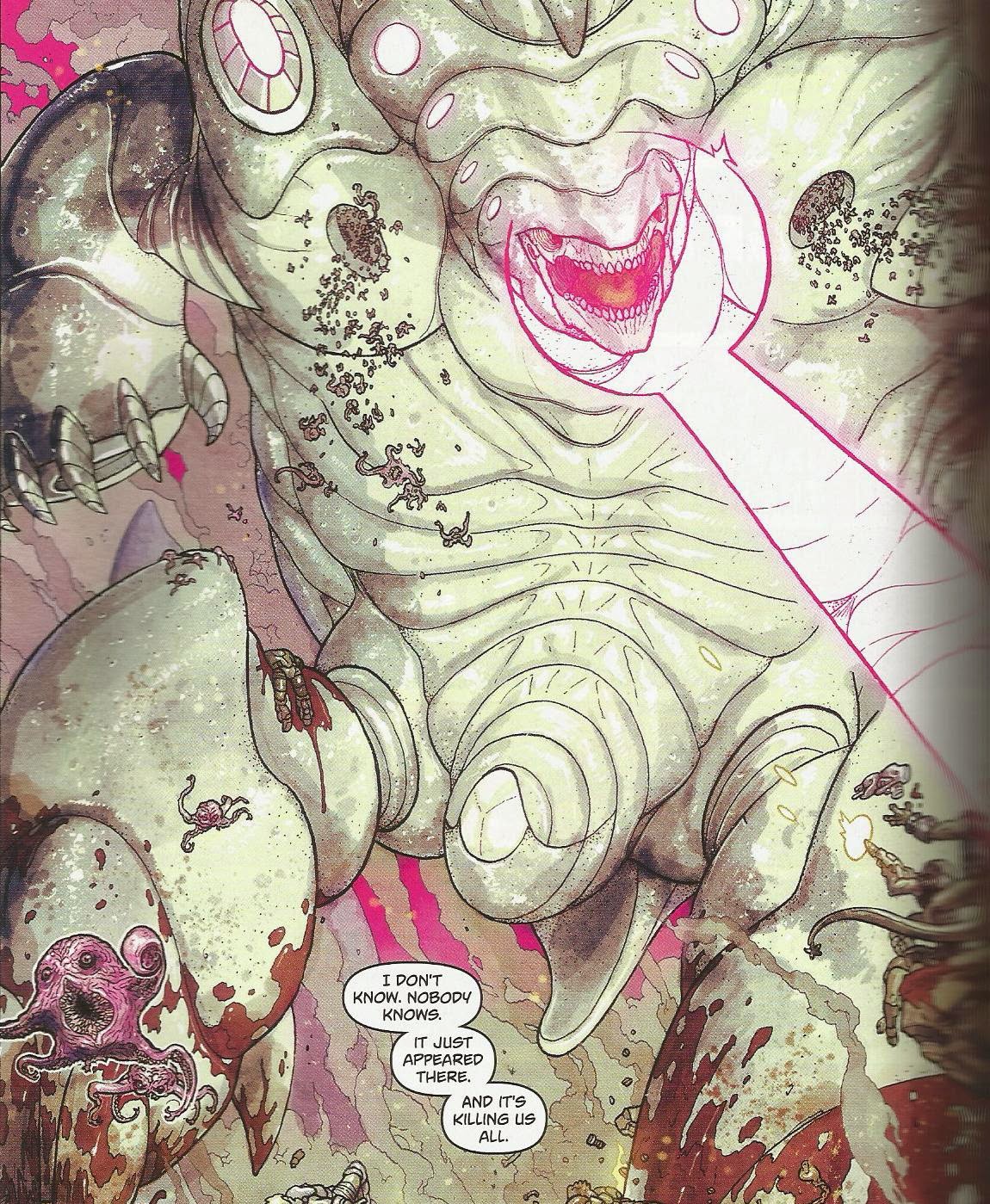
Glory and the strongest of the heroes go to attack the Knight head on in the sky, while the rest fight the army down below.  Nanaja gets attacked by parasites, and Badrock and Supreme goe to help her, but Badrock get's attacked by them as well.  Supreme says Glory's plan was doomed and that he should take over leading the army.  He attacks her and Beleszava goes to help her but gets killed by the Knight, as does Henry when he attacks it as well.

Supreme breaks Glory's arm to make her yield control to him, but she rips his arm off in return, just as Riley dreamt about in Book 1. Glory then mutates into a monsterious, bestial, one-eyed being, and attacks the Knight, ripping it apart.   Riley realises this is all happening as her dreams predicted and she says the following over images of Glory raging out of control:
Uh-oh
Riley: "I know the force Glory has become. I know she has no control over what will follow.  I know the devastation she will bring. I know the sacrifice she will make. I know she can't be stopped now.  Fighting her at this point would be futile.  I've seen what happens when we try.  I know I don't blame her.  I know this is all for the best.  I know what I am supposed to do now... Just know that in the end, I forgive you. I know this prevents something even more terrible. And more than anything... I will always love you."

And Glory rips her in half.
Nooooo!
This horrifying act snaps Glory out of her madness, and while a devastated Gloria kneels by Rileys bisected corpse, Glory can only mumble Riley's name in shock and sadness at what she has done.

The final issue starts with a flashabck to 1913 with Glory meeting a girl called Emilie who turns out to be the secret lover of Glory who was her constant companion during the early and mid twentieth century.  Back in the present we see a miserable and literally diminished Glory, minus an arm and with a shaved head.  Her father says he has arranged it with the freed Knights of Thule that she can make one trip to the afterlife, but this is a one time thing and when she dies for real, she'll be confined to the black void instead.  Glory doesn't care - "When do I leave?"
This heaven looks pretty cool
Charon rows her to the fields of the afterlife and she jumps out of the boat and goes running across to where Riley, Henry, Beleszava, Jim and Fabrice all are (Jim having died of a heart attack not long after Glory left) and she has an emotional reunion with them.  Glory wants to take them all away with her out of the afterlife and back to the world of the living.   But Riley assures her that while they appreciate her doing this:

Riley: "Your actions - all our actions - have consequences. In this case they're permanent. We're dead.  Like dead, dead... There is nothing to fix anymore. There's no reset button for anybody.  Even you."

Riley comforts Glory as she cries in her lap and says one day she'll find out that being dead is wonderful. Glory tells her that after the buried her, Gloria left and she doesn't know where she is.   Nanaja and Glory are getting along, and staying with their parents.  The new baby has been named "Riley" much to Riley's delight. Then Jim says that "she" is here.  Glory isn't sure if she should see her. Glory tells them that Emilie killed herself after she couldn't bear growing any older while Glory stayed the same.  And that was one of the reasons Glory became more unhinged, without Emilie to keep her in line.

Glory: "Who know's what she'll think of me now. What she'll think when she sees.."

Emilie: "G-Gloriana?"
Glory and Emile kiss as Henry, Riley, Jim, Fabrice and Beleszava look on

After their reunion, Glory realises she has to leave and she doesn't tell them she won't be able to return to the afterlife.  The story ends with Glory looking more like her old self, with a new arm, and the whole family, Glory, Nanaja, baby Riley and their parents pile into a flying, rocket powered van to adventures new.  How sweet.

It's not quite the end.  Tacked on are two final pages where two faceless men discuss the destruction of the Summoner and how the battle of Tokyo would have been an ideal debut for what they are planning.  They have a long time to plan and one day someone will "pull the trigger" for the "coming of Prophet".  And we see lots of cryogenic storage tubes as this is said.  These pages have literally nothing to do with Glory's storyline, but do have a lot to do with the series that was running concurrently called Prophet, and which is still running to this day.  I've only read the first three trades of Prophet and how events in them link back to these two pages hasn't been covered yet in them.

As for Glory, it seems these twelve issues are all there has been of this new look reboot.  I've checked out my local comic shop and haven't found any more issues on the shelves, and searching online hasn't yielded any useful information.  It's a great pity because Glory is a fantastic character and it was refreshing to have an unconventional looking main character in a storyline that prioritised female relationships in a way few comic books ever do even now in space year 2014.  I have to wonder what Rob Liefeld thought of the decision to make Glory bisexual.  When the X-man he created called Shatterstar was made bisexual and given a male lover he got pissed and very outspokenly said he'd undo it if he ever got the chance (not that him writing for one of Marvel's biggest cash cow franchises is ever going to happen in this day and age).  But female homosexuality is generally less contentious to homophobes, so he probably didn't care.
Glory and Emilie while still alive.
Glory Book 2 overall is a fantastic read.  It pays off plotlines laid in the first book satisfactorily, gives everyone a happy ending (of sorts) and sets it up nicely so if anyone else wants to pick up the series, there is room for a relatively fresh start to be made.  The characterisation is much better in this book with the writing improving by leaps and bounds, and it's genuinely upsetting when Riley is killed as you really care about her by then.  Nanaja is a lot of fun, as a being who doesn't take life as seriously as the straight-laced Glory and seeing the Extremeverse characters in action is pure 90's fanservice of the non-rude kind. Glory really feels like a character with history and totally shucks any last vestige of being a Wonder Woman rip-off to stand on her own two mighty feet. Ending with a plot reveal for a different book is a little odd, but if anything the Prophet reboot is even better than the Glory one and so encouraging people to check that series out can only be a good thing. I wish this Glory was an ongoing series, but these twelve issues across two books tell a self contained, greatly enjoyable story, with strong female protagonists and wonderful, wonderful artwork.  Great stuff.