Showing posts with label Crisis. Show all posts

Wednesday, 21 December 2016

True Faith (CRISIS #29-38)

"You just can't rely on anyone these days" - Terry Adair

Merry winter solstice blog faithful!  And what better series to celebrate Saturnalia or indeed the birth of the baby J than a (teenaged) Garth Ennis one about organised religion. Oh stop, it's not as bad as it could have been.  I don't actually think it's offensive because it's such a weird concept.  It takes the idea of someone having a massive crisis of faith and going utterly mad and who for some reason drags a misfit teenage boy into his crusade against the church, makes some vaguely cynical noises about God and the bible and ends with a literal bang as the misfit schoolboy discovers what truly he has faith in. Along the way Ennis swats his verbal hands at Margaret Thatcher, the S.A.S and dozy, uncaring parenting in a rather scattershot selection of targets that only hang together as well as they do thanks to Warren Pleece's superb and striking artwork.  This series ran in the lefty political comic CRISIS although I don't think Ennis's politics were/are very leftwing (nor rightwing, I'd describe him as a humanitarian liberal which he'd probably hate) but CRISIS was the most successful of the glut of adult orientated UK comics that appeared at the end of the 1980's, with this strip running in 1989.  So lets get this Xmas party started.

We begin in a church, where Terry Adair is praying.  Then we cut to a secondary school and our main protagonist Nigel Gibson is being taunted over his desire to go to a scripture because he fancies a girl in it.  Then he bumps into the P.E teacher who heard him say "wankers" and fines him fifty lines about swearing.

Mr.Hunt: "You really are pathetic Gibson. You never do anything worthwhile.  I never see you on the rugby pitches.  You don't dress properly.. you've got no respect for yourself."

He tells him he should go to the scripture class.  As he leaves Nigel notes the teacher will be there too eyeing up the talent.
Alienated teenager Nigel Gibson.
Back with Terry in church.  He thanks God for his job as a toilet cleaner salesman.   And he asks the Lord to watch over his wife who is currently giving birth, "please keep them safe Lord I love them more than anything. Um except you."

In the scripture class Nigel notes that everyone seems like "bloody zombies" spouting brainwashing material.  Then Angela Hyman, the girl he's attracted to gets up to make a speech.  She tells everyone that learning God's lessons when you are young helps stop older people leading you astray when you get older.

At the hospital, Terry is given terrible news.  His wife died in childbirth and the kid only lived a few minutes before dying as well. Terry goes into deep shock.  After scripture class, Nigel walks with Angela and asks her about the whole "women are wicked" thing. She says everyone has their place in the eyes of the Lord.
Deeply traumatised Terry Adair.
Nigel says that if it was a politician you wouldn't believe this stuff.  "But it's not a politician, it's God" counters Angela.  Nigel asks if she ever feel about cutting loose.  "I can't be weak Nigel, it's a sin" she responds.  He tentatively invites her to the pub and she agrees to come saying she is allowed to have fun.

Terry's wife and child are buried.  At the wake afterwards a couple of the people say that everyone there is mostly the wife's friends. Terry has no one to help him get over it.  Later when everyone is gone, Terry goes and kneels by the two graves.  He then yells at the sky:

Terry: "Are you listening God? I swear on their graves I'll kill you for this!"

Nigel arrives at the pub to meet Angela only to find she's bought along some of her fellow bible bashers.  "Ah shit" he says to himself "she thinks I want to be a bloody Christian". He orders himself a beer and sees Terry hunched over the bar and thinks, "I don't know what your problem is mate.  But you look just the way I feel."
An unbearable loss.
Nigel sits with the group and downs his beer.  One of them says that when he decided to become a Christian he faced ridicule.  Nigel says he hasn't actually joined.  Another asks exactly what he wants to know:

Nigel: "Just little things really... how do I find faith.. what being a Christian means in todays society... which prayers do I use... And of course why you think I'd want to follow such a mindless cop-out philosophy as Christianity anyway. You pricks."

They get into an argument as Nigel insists God doesn't exist and the bible is bunk.  Mike, the jock and "Golden Boy" according to Nigel tells him "his sort" never do anything of their own and make fun of those who do.

Mike says he's better than Nigel because he's on the rugby team, he's doing well in his A'levels and is nearly done doing a Duke of Edinburgh award.  Nigel says he is arrogant to think everyone should care about achieving the same things "just because you want it, everyone else has to want it".

Terry overhears Nigel's criticism of the God squad.
Terry is listening intently to their argument as Nigel carries on putting the verbal boot in saying "I've got my own values."  He doesn't get them from a vicar handing them out on a plate.   Nigel says "God looks after people, all he asks is that they give him their love". Nigel retorts "and their free will".  Then Terry lurches over to them and tells Mike to shut up.

Terry: "Bollocks!  He doesn't give a shit! You wait! You just wait until your rising main stop valve is loose!  Because that's when it counts, son. That's when it matters. And when you're disappearing round the 'S' bend and God still hasn't turned up with a half inch spanner and a plunger.  Well.  Then you realise how much the Lord cares about you".

He then tells them he's going to kill God and leaves.  Nigel gets up to follow him.   When Angela tells him not to, Nigel says he only invited her out because he wanted to "get into her knickers" not have a bible study class.  And he follows Terry out of the pub thinking "he's probably completely harmless".

He ends up in a derelict flat, on the table is a shotgun and under the table several molotov cocktails.  There is a diary there as well which he picks up and starts to read.  Up to the birth of his son it's normal stuff.  Afterwards it's paranoid ranting, he writes that "God has become a blockage.  I need a plunger."

His plan is to go and create havoc in the houses of the Lord until he can get Him to show his face.  We cut to Terry fire bombing the inside of a church, sticking two fingers up at the burning crucifix and blasting the vicar with a shotgun.

Terry's diary: "He will want to meet his nemesis.  And then I will look into the face of God. And with all the reverence due to a blockage in the 'S' bend of the world.  I will unblock him.  I will snuff him out."

Terry upon reading this starts to make a run for it only to bump into Terry returning from his church burning excursion.  Terry tells him to sit down and listen.
Nigel stumbles into something bad.
He remembers Nigel from his arguing with the bible group.  He asks his name and is told it's "Nigel Gibson".  Terry says he could kill Nigel now he knows about his mission but feels a "certain kinship" with him.  He then starts ranting about his word being Law and Nigel needs to keep his mouth shut and obey because he has a twelve bore shotgun standing very near him.

He then lets Nigel go and he flees.  On the way he comes across the burning church and realises Terry's crusade is a very real one.  He gabbles to the police constable there that he knows who did this.  The cop says he'll take a statement after he's checked the alleyway.  Nigel hears a scream and goes to look only to find the policeman dead, hanged from a fire ladder by Terry who says "Lawbreaker" to him.
Terry practices what he preaches.
Nigel runs again, while Terry mulls over the fact he'll run home to the warm and get his father to phone the police.  We then get a look at Nigel's family.  His parents seem unconcerned that it's eleven o'clock at night and he's still out.  His sister says he's a "weirdo" and embarrasses her.

Back with Nigel, he's being stalked by Terry as he heads home.  He runs thinking to himself that his pet dog will attack Terry only to find his dog crucified on a saltire.  He runs again in absolute terror as Terry muses that "his four footed angel of deliverance has fallen too far to do any good."

Terry ends up cowering in a dead end alley as Terry approaches him Nigel says he gives up, Terry can obviously kill him anytime he wants.   Terry says he won't kill him, Nigel is Terry's son now, "we should make merry and be glad."  He embraces Terry saying he will help in his mission to deal with the blockage, "my son".
Not cool Terry!
Sometime later we see Nigel helping Terry make molotov cocktails as he silently laments what has bought him to this situation.  If he refuses to help, Terry will kill him:

Nigel: "He convinced me of that last fact beyond a shadow of a doubt.  I believe him.  I have faith in him. Great faith."

Nigel asks Terry what he will do when God comes down to face him.  Terry says God is powerful because he is an idea.  Destroying the idea behind him requires a potent symbol and he picks up a revolver.  He points it at Nigel and recites Clint Eastwood's "do you feel lucky punk?" Dirty Harry speech.  He says the idea behind those words has power, "they are equal in the minds of the people to the words of God. They are my weapons to destroy him".

They firebomb another church, as it catches fire Terry shoots the vicar in the leg then grabs him and smashes his head into the font repeatedly screaming "blocked!" As they leave they are grabbed by some men dressed all in black and dragged into a van.  They are dumped in front of a sinister looking man who says they have been burning churches and that "I think we're going to be very good friends indeed."  Nigel thinks to himself:

Nigel: "What Terry Adair does is illogical.  It's insane.  It's stupid. It causes the death of innocents and the destruction of all they hold dear.  And all of that means nothing to him whatsoever.  I think Terry Adair is the nearest I'll get to actually meeting a god."

But as he and Terry kneel before the sinister man, Nigel wonders what that makes him.  The man introduces himself as Cornelius Garten.   The men are his commandos and they've decided the source of the world's sorrows much be removed.
The sinister Cornelius.
That source is God.  After some more subtle attempts to influence peoples views on him they decided to take direct action and go after the churches. Imagine his surprise when someone else started doing what he'd planned.

Terry asks what he wants, Cornelius says "recruits". In his view God is a cancer.  "Blockage" says Terry, "Cancer" says Cornelius until Terry gives in and says "cancer" too. Then Cornelius shows them a huge number of guns and molotov cocktails he has stored up.  Then they go on a church burning expedition.  Cornelius says he's impressed with them an Terry mumbles "thankyou Cornelius".  Nigel puts his head in his hands and thinks:

Nigel: "I thought Terry Adair was a god.  He threw off his religion and thought for himself. And, even though he was off his bloody rocker, he wasn't being led like a sheep anymore.   But with that bastard Cornelius.. well now Terry's back in the flock. Which means I'm even further up shit creek".
Happeeee Christmas!!
We then cut to a mass of newspapers all leading on the spate of church burnings.  Mrs. Thatcher in shadow is asking some of her cabinet what they know about this. One of them suggests that it's Satanists.  Thatcher says no, she asked Norman (Tebbit I assume) about it and he says it definitely wasn't them, at least not from his coven. Heh. Thatcher says she's not interested in why this is happening, only what they can do to stop it happening. "It's time to take action" she says.

Meanwhile a depressed and run down looking Nigel gets ready for school.  His parents say he doesn't seem himself lately.  As he leaves, his dad says it's probably just a phase.  His sister says, "He's been in a 'phase' all his life dad.  He's a real dippo".  Sadly Nigel leaves the house and drags himself to school.
Nigel's life sucks.
At school he has the piss taken out of him by some sneering aresholes.  He ignores it.  Later he is sitting alone in the dressing rooms and Mike the jock confronts him over what he said to Angela back in the pub a while back. He yanks Nigel up and says, "I hate you Gibson.  You and all the scum out there like you".  He pushes Nigel off the bench and walks off, Nigel spots a cricket bat and smiles.

Then we cut to him in the headmaster's office.  He's being raked over the coals for bashing Mike over the head with the bat. Nigel lies and says Mike exposed himself to him which enrages the Head.  He says Mike is vital to the rugby team, top of most of his classes and a committed Christian.  Nigel is a "reptile" who nearly killed him and for that he gets two weeks suspension.  He tells his parents this over dinner, they react mildly telling him to "buck up a bit".

Back to Thatcher, she is observing a conversation two of her ministers are having in the toilet via a CCTV camera in there.  She has a bank of monitors in front of her.  She ponders the comment one of them said that she was overreacting, then she gets on the phone and calls for the S.A.S.

While his family watch the news, Nigel gets a call from Cornelius saying tonight he has to come along, Terry insists.  Then we cut to a room full of S.A.S men, they have men undercover at several major targets.  If they are attacked they'll call and they can be there in minutes. They are told that if the arsonists aren't carrying guns, they need to make sure they are once they are dead.
The attack commences.
Nigel arrives at Cornelius's place.  Tonight they are planning an attack on "the big one." Nigel regards the passive Terry with irritation thinking for all his big talk he folded up in front of Cornelius.  "Mind you, you had me on a roller coaster ride to hell long before he came along" he thinks to himself.

The big one turns out to be Saint Paul's cathedral.  They go inside and start throwing fire bombs.  They shoot the man who comes to see what's going on, but he's actually one of the undercover S.A.S and as he lies on the floor he calls for them to come.  He then gets up and reveals he's got a machine gun.  Cornelius shouts to Terry and Nigel to run back to the van.  But the way is blocked by a wall of gun toting S.A.S men who open fire upon them.

Cornelius, Terry and Nigel run into a side room as the rest of the their "soldiers" are gunned down.  They crouch down and Nigel starts gibbering "oh shit" over and over.  Cornelius calls him a "worm". Terry meanwhile stands up and declaims that the blockage is coming forth "and it's like unto a great and mighty number two".  Cornelius tries to snap him out of it.

We get a quick cut to his parents discussing Nigel, they think he'll do better when he starts work.  But they aren't even sure when he goes back to school causing his sister to facepalm.  Back with Nigel, Cornelius shouts at Terry that his wife wouldn't have wanted this.

That snaps Terry out of it, because he never told Cornelius about his wife.  He wants to know how Cornelius knows and Cornelius says, "I killed her."  He paid off the doctor to "balls up the birth".  He wanted Terry to lose his faith so he could become a true commando.

Cornelius: "That's how I got them all... Find someone who's utterly devout. Inject a bit of personal tragedy to kill off their faith.  And bingo!  Instant fanatic!"

Cornelius rambles on that in two thousand years there could be a religion about what was written of his methods.  Nigel asks "why" he did all this?  Cornelius shouts that God killed his wife in the middle of childbirth, "do you think I'm goning to let him get away with that?!"
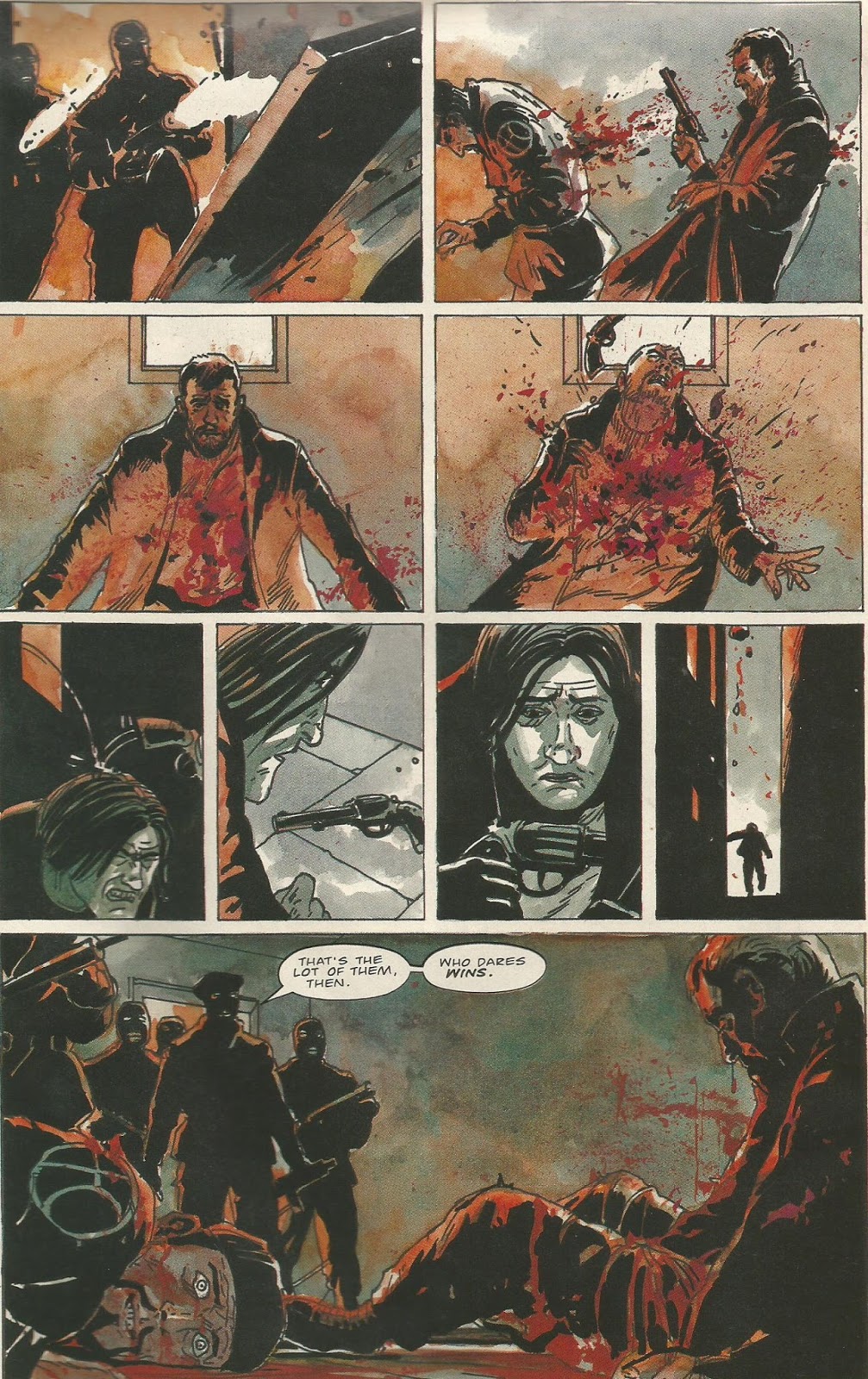
But the S.A.S swiftly end it.
Terry lets out an anguished scream which alerts the S.A.S as to where they are. He says sadly, "I've been mad.. I've been mad.. I've been insane for so long."  Cornelius grins at him as Nigel makes his escape through a small window, and says that he is still insane himself.  Terry points his gun at Cornelius but before he can shoot, the S.A.S burst in and kill them both, Terry's gun flies up and out through the window and hits Nigel who picks it up and makes his getaway.

Next day Nigel is at school even though he is still suspended, drinking vodka.  Angela comes up and asks him if he is Ok saying he doesn't look well.  Nigel has a serene quality about him and when Angela says there is something odd about him today, Nigel says she wouldn't believe how odd.

Then the P.E teacher appears and says him being there drinking gets him an audience with the headmaster.  Nigel tells him to "go and fuck yourself".  The P.E teacher rounds on him for swearing only to be faced with a gun pointed right at his head.  He whimpers and Nigel pulls the trigger blowing the man's brains out.
I hated my P.E teacher too, but even I wouldn't have shot her.
"Holy shit" shouts Angela, and Nigel says "that's the whole point Angela."  He goes outside and sits on the steps.  He hears the alarm and knows the police are soon to be on their way. Getting the kids out "so the police marksman can do their job".  He thinks to himself that they went look for God in the wrong places, he's inside of us all because "we invented him."  He thinks that Terry, for all his madness, showed him something:

Nigel: "He just did whatever the hell he wanted. And I guess that's the lesson I learned from him.  So here I am.  Free. And that's the way I'm staying. I've got faith in myself at last.  True faith. But then I was bound to say that sooner or later."
It began with anger and ends in calm. Only the warm embrace of death waits for Nigel.
Well there you have it.  Is it in poor taste me bunging up a post in which one of the main characters compares God to a giant poo stuck in the 'S' bend of life during what for some is a very God orientated celebration?  Maybe.  My family celebrate Festivus, we put up our aluminium pole and take part in the annual airing of the grievances and the feats of strength so I feel a little naughty this time of year.  This is I think only the second series Ennis had done after the excellent debut Troubled Souls which I have already covered (I'm not sure when he took up regular writing duties on Judge Dredd post-Troubled Souls).  I feel like he was torn between wanting to say something profound about religion  and wanting to let his more grotesque sensibility off the leash for the first time and ended up falling between the two stools. Although it does feel like a trial run for the Preacher series many years later which starred a man of faith who wanted to find a runaway God and take him to task for his perceived failings. Nigel is the most well drawn of the characters, even if his story is incredibly depressing, with the ending implying all he has faith in is the gun and that he intends to die now, taken out by a police marksman. Maybe if I put my feminist hat on we can figure his plot arc out. Perhaps prolonged exposure to Terry's madness as a surrogate father figure railing against the ultimate patriarch affected him because his parents barely care about him, his sister is embarrassed by him, he's mocked by his peers and is unable to score with the girl he fancies who is dating the arsehole jock.  It all creates a brew of resentment stoked by a culture of toxic masculinity that finds its final expression in the power vested in him by the possession of a gun, the ultimate phallic symbol.  And he uses it to murder the P.E teacher and head of the rugby club, the alpha male if you will, taken out by the belittled and humiliated beta male.  So in the end, not a series that was really about religion at all, just plain and simple male entitlement.  You can breathe a sigh of relief now.  Happy holidays peeps, see you in the new year. 

Wednesday, 15 June 2016

Troubled Souls (CRISIS #15-20, #22-27)

"And I'm a murderer.  But I don't tell Liz that" - Tom

Garth Ennis has always been disgustingly talented.  This story was his first professionally published work, and while a little rough around the edges, deals with a difficult and emotive issue - the Northern Irish Troubles - with even handedness and tact.  By showing us an everyman caught up in events he barely understands, Ennis finds humanity amongst the horror of terrorism and living under the threat of terrorism and shows there were no easy answers to a conflict who's roots go back centuries.  Published in CRISIS, a comic for oldeer teens and adults, in 1989 when he was just nineteen (!), Ennis who self describes as an atheist takes no sides but that of his main character Thomas Boyd who finds himself an unwilling party to an act of violence and who tried desperately to justify just what he has been dragged into, although guilt and self knowledge work against his denial.  This is also Ennis's first collaboration with artist John McCrea, an artist he's still working with today (All Star Secion Eight from last year being the most recent). McCrea's artwork is a little different here, less cartoony and designed to fit in with the painted styles that were so fashionable in UK comics at the time.  His character designs are still very identifiable, and though I usually am not keen on painted artwork, the subdued nature of it here suits the extremely serious subject matter in question.
Tom.
We are introduced to Tom having just signed on the dole, he has his I.D. checked by a British soldier, "must have caught him on a good day" thinks Tom as the man pleasantly sends him on his way, "or maybe it's just he realised I'm a Prod [Protestant], like"  He goes and joins his mates in the pub, Dougie, Valerie and Liz, a girl he really fancies.  Tom scans the pub thinking, "Aye, just ordinary people having a drink".

He gets tricked into buying a round of drinks and as he goes to the bar, a man with a moustache raises a glass to him, much to Tom's confusion. Back with the others, they tell Liz about a lads camping trip he and Dougie just got back from.  In the toilet later, Tom asks Dougie why Liz is there, he knows Tom fancies her.  Dougie just sings and refuses to be drawn.

When he gets back to her, she asks him about going exploring when he was off camping.  Tom stammers that he hates sitting in one place, "festerin'".  She smiles at him and says, "That's really nice.  I like that in a man".  Tom mentally exhorts himself to not be a prick and lamely responds, "Oh yeah, that's me alright."

As he kicks himself, three officers from the Royal Ulster Constabulary enter the bar.  The man with a moustached gets up and drops a package in Tom's lap before being taken away by them.  Tom opens the package and to his horror finds it contains a gun.
An unpleasant surprise.
Frozen in place, a million thoughts race through Tom's mind.  He thinks he should just get up, go outside and hand the gun to the law:

Tom: "What in God's name's the matter with me?  Somebody dumps a gun on you, you tell the peelers [police].  You don't just sit there like an eejit.  So why don't my legs work?  Im - my God - I'm too scared".

The moustached man returns to the bar and Tom goes over to him and hands him back the gun saying he won't breathe a word of this.  The man spits out blood and a tooth and replies "with that attitude you could go far."
Introducing Damien.
Next day at home Tom gets into an argument with his patriotic father.  When he questions his dad's describing "Taigs"[Catholics] as "bloody animals" his dad goes ballistic.  Luckily Tom is rescued by his brother Andy, he says in this country people pass their hate along to their kids "this wee country's a mess because of it".  So he's leaving for England where job prospects are better.  He tells Tom to go see their Aunt Angie.

Tom does so because he needs to talk about the gun incident and he knows he can trust Aunt Angie with his secrets.  She reassures him that there was nothing he could do.  Tom says "the peelers had hit this fella - he was spittin' blood an' all".  When his aunt says but the man was planning to do something bad with the gun, Tom says "he hadn't done anything yet".

Aunt Angie: "You either have to live with the Troubles or leave, like Andy's doing.  Picking through the rights and wrongs of it'll get you nowhere".

Feeling a little better about things, Tom gives her a kiss goodbye and walks off down the road.  Waiting for him, slouched against a lampost is the man with the moustache.  They go to a nearby cafe and the man gets them both a cup of tea.  He tells Tom he is after someone reliable, "someone who swears he won't say a word.  And actually doesn't".
An unwelcome stalker.
Tom gets up to leave, he wants nothing to do with him.  The man makes veiled threats against Tom's family and Liz.  Tom sits back down.  The man says his name is Damien, "and I work for people who don't like the people in charge of this country."  Tom says he's not killing anybody.  Damien makes threats again. Tom says "they'd rather die before seein' me out killin' people".  But when Damien says "Suppose you'd be glad to oblige" Tom cracks and pleads with Damien not to hurt them.

Damien: "Aye, I thought so.  Bloody Prods... this wouldn't even be necessary if you'd wake up to the Brits playin' their con-tricks on you for hundreds of years."

He leaves saying Tom will be contacted and not to do anything silly.  Not long after Tom leaves as well, and thinks about what Damien meant when he talked about "con-tricks".  So he goes to the library to research the history of the Irish Troubles and we get a slightly inelegant text dump over three pages, if you want to depress yourself, read the up on it on wikipedia.  Spoiler, it has a (relatively) happy ending.
Take that history!
Afterwards Tom thinks it was enlightening but hasn't helped him with his problem.  Later Tom joins his friends, it's evening of July 12th the day a Protestant celebration takes place.  Liz isn't there though, and Tom isn't in the party mood.  As he starts to think sympathetic thoughts towards the Catholics his inner voice won't shut up contradicting him.

Tom: "(Maybe it's all one bloody awful mess and believing on sides better than the other is the first sign of a thoroughgoing prick)"

He walks home thinking; "I'll have to do what Damien wants (You gutless wee shite)."

Next day Tom is walking with Damien who says they are going ahead with the plan in a few days time, "the destruction of a British Army landrover".  Tom will most likely act as lookout, and when Tom blanches at this, Damien tells him to clear off and think about what will happen to his family if he tried to wriggle out of it somehow.
Liz.
Later in the pub he bumps into Liz.  She joins him for a drink but says she'll have to be going soon as she is visiting her aunt who lives in a posh area called Cherry Hill.  Liz says she's a "rotten old cow" and would Tom like to come along too?  He agrees and they take the bus out there.

She is indeed a horrible snob, and is politely rude to Tom.  She says she's just back from visiting Scotland and that when people on the mainland find out you are from Northern Ireland they are full of sympathy and wonder if you've ever been shot.  But she says the violence is in places, "one just wouldn't go".  This angers Tom into saying that people who live in those places don't have a choice in the matter.

Aunt Sarah: "Thomas.  I never forget that those people live there.  The fact they're allowed to live anywhere is on my conscience every waking moment."

Liz quickly changes the subject to gardening and Tom escapes with his life.  As they head back home he apologises, but Liz says she "wouldn't have taken you for a social reformer".  Without thinking, Tom responds "Ah-ha.  But would you take me at all?"  Liz just smiles, then comments that everyone has a nasty aunt.  So Tom takes her to visit Aunt Angie to prove her wrong.
You're in there Tom!
After a pleasant evening round there, Tom walks Liz home.  He asks her out for a drink sometime and she responds with a passionate hug and kiss that he decides to take as a yes.  feeling cheerful he walks home singing, then Damien comes out of the shadows and tells Tom it's been decided what he'll be doing, not acting as lookout, "you're planting the bomb".

We next join Tom on his way to plant the bomb in a litter bin attached to a lampost.  Damien's told him the bomb will "maybe just knock the soldiers about a wee bit".  Tom thinks that's a lie, and maybe Damien doesn't have the clout to hurt his family like he threatened.:

Tom: "And I'm still about to plant the bomb.  All because Damien was lucky.  He found just what he needed when he found me.  A coward."

He desposits the bomb, then realises Liz only lives a couple of streets away, which throws him into such a panic he goes and hides out at home to get his head together.
The reluctant bomber.
His best mate Dougie calls round and they hang out together for the day.  They decide to call on a friend called Ivor who has just got out of prison.  He joined the Ulster Volunteer Force, but shot himself in the foot before he could hurt any Republicans.  They watch Full Metal Jacket on video and afterwards Tom says he found it depressing.

Tom: "The soldiers in it.  They acted like animals, but they were just like us at the beginning.  What I mean is they were turned into that and they had no choice..."

The other two think he's "talkin' shite".  Ivor says the soldiers who arrested and roughed him up were bastards.  Tom and Dougie leave and Dougie mentions that Tom has been seeing Liz recently.

This makes Tom suddenly remember the bomb and the fact its due to go off very soon.  He rushes to a payphone and calls her house, but it told she has nipped to the cornershop close by for some milk.  In a panic, Tom runs off to get to her before the bomb explodes.
Quick!
He goes belting down the road to where Liz is coming out of the shop and the landrover is turning into the road approaching the bomb.  She is surprised to see him, he babbles something about meeting her parents.  When she asks if he is OK he hurries her on saying he is fine.  They near the corner around which safety lies but his mind is racing again.

Tom: "Now.  Get her out of here.  Go, go, go! (no.  Turn and look).  Three steps and we'll be round the corner, just keep moving - (Look).  For Christ's sake get out - (You're responsible for this. LOOK)."

And a shattering explosion hits the landrover, while Tom is struck in the leg by some shrapnel.  He sees one of the soldiers alive for a few seconds die in front of him and passes out.
Blood on Tom's hands now.
He comes to, telling Liz he is dying and that he loves her.  She tells him not to be daft, and as the ambulances arrive she says he'll be fine.  As he is loaded into one she tells him she'll come visit him at the hospital.  But all he can think is, "so I'm going to live, then.  Pity."

Recovering in hospital, Tom is visited by his aunt then Dougie and Valerie, who are getting married due to pregnancy and Tom will be best man.  Left alone, Tom idly watches a news report on some TV coverage of the shooting of an R.U.C officer the night before.  He notes the saminess of the coverage of the Troubles, skimpy report, condemnation from a politician, no words from the IRA due to reporting restrictions, then a "funny" item to follow so people won't get depressed before they tune in to Neighbours.

Tom: "We've had twenty years of the Troubles.  They probably got bored of it over the water in '71 or so.  And we're as bad.  We wake up, hear about the nights murders, mutter 'bastards' at the radio and forget about it."

After sending a Daily Mail ("evil") reporter away with a flea in her ear, Liz comes to visit.  She thanks him for saving her life, and for declaring his love, "I reckon I'll stick with you wee fella" and she kisses him before she leaves.  "I don't deserve her one bit" thinks Tom.
The Daily Mail - always been evil.
Meanwhile Damien is getting bollocked by his superior, "Mr Rourke" is angry Damien involved a Prod.  He calls his actions cretinous then gives him an ultimatum, Tom is a security risk, "It's you or him".  Damien has to kill Tom now to protect himself. 

We then get a peek into Damien's mind as he stalks the recently released from hospital, Tom. When he realises that he's going to shoot him with the same gun Tom held for him back in the pub, guilt wells up inside him.  He bears down on a terrfied Tom and thinks, "Oh Christ - I can't do this".

We then jump to Tom on an island called Rathlin of the north coast of the country.  He remembers how when he saw Damien he just ran, Damien could have caught him what with Tom having a bad leg, but only chased him about twenty yards.  Tom took his brothers old car and fled to the island.
Tom relaxes in the Northern Ireland the news doesn't care about.
He mulls over the fact that this is the Northern Ireland the people on the mainland don't see.  It wasn't always so peaceful though, invasions and massacres happened about once every hundred years.  But now the place is quiet and untouched by violence, "can we leave the violence behind too?  Can I?"

He phones Liz and lets her know he is OK and that he just needed some time alone after what happened.  "Hurry home, eh? See ya!" she tells him and he regards the phone thoughtfully saying "Aye right..."  And he catches the boat back, he "done enough running", he's going to deal with whatever gets thrown at him head on.

Damien is speaking with Mr. Rourke again on a hill overlooking Belfast.  When Damien admits he hasn't killed Tom yet, Rourke says that Damien has not only been unable to deal with a security risk, he's become one himself.  If he won't kill Tom, Rourke will get someone who will and Damien's days will be numbered.
Damien is given the kill order.
Angrily Damien says he'll do it.  Then a car with some U.V.F (Ulster Volunteer Force - Protestants)  members pull up, there for business reasons.  Damien is aghast the I.R.A would be colluding with the enemy like this, Rourke merely says, "if you've been asked to carve, then you ought to make sure you can see the turkey."
A subdued Tom gets ready for a meal out while his father tries unsuccessfully to have a conversation with him.  He is similarly quiet over dinner.  On the way home he ignored a blatant come on from Liz, and after walking in silence for a while she stops him and asks what's the matter.

He lies to her saying he doesn't have a clue.  After she leaves him and he carries on home, he thinks about the six men he murdered and how he tried to justify it and how he can't put it behind him.  Then Damien appears pointing a gun at him.  "Don't run.  Please" he says.
Damien captures Tom.
In a deserted house, Damien is holding a terrified Tom prisoner.  Tom won't talk so Damien sits and tells him about his brother Jamie who died in the crossfire when the Provos (I.R.A) ambushed a British army patrol. He blamed the British and and soon as he got the chance, joined the Provos, "I was perfect for them an' all.  A grudge against the British... young... idealistic."  He says he's only twenty-three and has done evil things.  "I've ruined my own life and probably yours while I'm at it" he tells Tom.

He says the night he dropped the gun in Tom's lap he targeted Tom as being too scared to do anything about it.  Tom says he was right, "perfect material."

Damien: "Aye.  There'll always be perfect material and there'll always be leaders to use them.  I think the worst thing I did was to be a leader."

As night falls they start drinking. Damien says he's become disillusioned with the cause, seeing how both sides have Belfast stitched up between them, keeping a war boiling so, "nobody notices you bleedin' the city white".
Tom and Damien bond.
After more chatter on the history of the Troubles, Damien asks if they can talk about something else.  And as night carries on they chat, and drink, and bond and Tom realises they've become friend as they shake hands.

Tom: "And if we can be friends, I think to myself if we can do it, surely everyone can?"

The next day dawns and the R.U.C are staking out the house.  As a hungover Tom shakes Damien awake, the police open fire on the building.

Somehow the pair of them escape and walk to a nearby village where they get a car, as they drive back to Belfast, Damien says he believes his I.R.A buddies tipped the police off as to where he would be.  He tells Tom about NORAID, the Americans who fund the I.R.A and how they invite a group to come see how their money was being spent.

Plenty of Irish Americans with blood on their hands.
He carries on talking about the hypocrisy of the I.R.A, "getting bitter and angry".  Back in the city, Tom looks around at the people just living their lives and realises he wants to be ordinary again.

Tom: "I want to get rid of my Troubles.  And even though it's a betrayal of everything Damien and I have realised.  Of everything we've understood.  Of our impossible friendship, I do it anyway."

And he jumps out of the car and runs with Damien in pursuit.  When Damien thinks that Tom thinks he is going to shoot him, he takes out the gun and shows it to Tom saying it isn't even loaded.  And the nearby soldiers gun him down, killing him instantly leaving him dead at Tom's feet.
Damien killed by British soldiers.
A few days later Tom is packing to leave for the mainland.  He goes to say goodbye to his family, his dad says travel should help him "get over your trouble".  He hugs his mum and aunt before leaving.  He goes and says goodbye to Dougie and Valerie, then finally he meets up with Liz.

She can't believe he is leaving, he says he can't stay.  He tells her he's had enough of the city, "it's really bad and nobody's doin' anything about it."  When she tells him not to give up or they've won, he says sadly, "they won a long time ago".  He admires her strength in putting up with it, "you're stronger than me".  She looks away silently and we end with Tom on a ferry contemplating the loss of her and how Belfast looks at night.

Tom: "You just wouldn't know looking at it like this.  All you can see is lights.  And you're so desperate to see lights that you don't dare think about what's going on in the dark.  The war goes on."
Tom leaves his home, perhaps forever.
At 11:17 am on Saturday the 15th of June 1996 an IRA bomb detonated in the centre of Manchester.  It was the largest peacetime bombing that has ever taken place in Britain, and yet miraculously there was not a single fatality, and while two hundred and twelve people were injured, considering that a couple of hours earlier between 75,000–80,000 people were shopping and working in the vicinity, the evacuation can be considered a major success.  The next day I stood at the fenced off end of Corporation Street and looked at the wreckage and felt such a surge of pure hatred I was almost knocked off balance.  Younger people might not realise how inured you got to the weekly reports of bombings both in Northern Ireland and on the Mainland, but this was different.  This was the city of my birth.  The city whose university I was about to graduate from.  The city I still describe myself as coming from even though I live in a town next door now.  At that moment I wanted nothing less than Total War on the IRA and their sympathisers and would have supported any kind of retaliation no matter how bloody.  And yet, it ended up being the last major IRA attack on the UK mainland, and when I'd calmed down a bit I realised that though I'd never be happy seeing terrorists as respected politicians or released early in the name of peace, it was better in the long run for that to happen, to make those concessions than to keep on going with a miserable little  war that had claimed thousands of lives over thirty years.

Having grown up in Northern Ireland and been a child during the worst decade for violence - the 1970's - Garth Ennis still manages to give us a story that shows how hard it was even for the apolitical to stay out of involvement in The Troubles.  Tom is a likeable character, and by showing his unremarkable life with family and friends who love him, his life being pretty much ruined by a man who could be said to represent not the IRA but the violence of both sides, Ennis is making a statement about how all encompassing that violence was (and he'd deal with the organised crime/collusion between the IRA and UVF in his Authority: The Magnificent Kevin mini).  At least I didn't have to deal with soldiers on the street corners when I was growing up, soldiers who might resent the people they were ostensibly there to protect for dragging them into a guerilla war as much as the people they were fighting against.  Troubled Souls is an extremely mature piece of work, that while suffers a little from perhaps trying to cram too much in via the history lesson section, nevertheless shows many Garth Ennis tropes he'll go on to refine in future works such as solid male friendships, strong women, pubs, naturalistic working class language and an interest in the military.  Ennis himself is somewhat dismissive of this series saying of it that it was "the kind of thing that was doing well at the time. (...) With hindsight, what Troubled Souls really represented was naked ambition. It was a direct attempt to get published. And that was the road that seemed most likely to lead me to success."  But even so, I still find it a strong debut and one of the best strips CRISIS featured in its sixty issue run.  The follow ups, which featured more of his trademark humour I am less enamoured of, but along with fine work from John McCrea Troubled Souls is a fascinating snapshot of a period of UK history we'll hopefully never return to and the start of a long and illustrious career for Garth Ennis.

Sunday, 20 July 2014

The New Statesmen (Crisis #1-14, #28)

Cover from a US reprint
Dalton: "...I've been thinking... this isn't much of a 'happy ever after' is it?"

Burgess: "No. No it isn't".

In 1988 the UK comics industry was in rude health, and the publishers of much loved sci-fi comic 2000AD decided to bring out another fortnightly anthology comic called Crisis, aimed at adult readers.  It ran for sixty-odd issues and was most notable for it's distinctly left-wing slant most obvious in one of the two debut strips - Third World War.  It's the other strip that ran in the first fourteen issues that we're talking about today though.  The New Statemen, written by John Smith and mostly illustrated by the fantastic Jim Baikie (both credited as co-creators), with a few issues done by Duncan Fegredo and Sean Phillips.  It's a complex tale of artificially created superheroes called Optimen, each one assigned to a US state, in the year 2048 that also sees England (and England alone) as the 51st US state (a common left wing nightmare scenario at the time). 

Frankly the story is so crammed full of detail it becomes somewhat inchoherent and is somewhat undisciplined structurewise making it hard to follow in places, squeezing too much detail in too few pages. In the following summary I've simply concentrated on the storyline following the three main characters, Dalton, Burgess and Meridian, stripping out all the side-plots and characters that only appear for a couple of pages overall. I know at the time, I was fourteen and mostly enjoyed the strip for Jim Baikie's art which I tried so hard to emulate and my interest dropped quite dramatically when he wasn't doing an issue as the writing didn't particularly draw me in back then.  The story really needed more space to expand, to understand it fully you had to read the densely wrtten text articles that began each issues story.  These provided historical background in the same way the text parts of Watchmen did.  Unlike Watchmen you really did need to read them to understand what was going on, rather than them being an optional extra.
Each strip opened with a text piece
What's interesting about the strip is it's yet another example of the suspicion British writers have for the concept of the superhuman.  Like Watchmen before it, and Marshall Law right up to The Boys after it, it gives us superhumans that can only operate legally as tools of the government or military-industrial complex.  The story begins with the introduction of five Optimen called the Halcyons, made up of Cleve (Ohio), Dalton (Georgia),  Meridian (Mississippi), Vegas (Nevada) and Burgess (England).  Burgess is alone in his room having flashbacks to torture they were undertaking under orders from the government.  The flashback continues to them taking on the ELA (English Liberation Army) at a place called Tariq Alley (a little in-joke, Tariq Ali is a well know left wing firebrand in the UK).  Burgess's powers went out of control and many innocent lives were also lost that day leaving him somewhat depressed and withdrawn.
Burgess, wracked with guilt
Meanwhile, Dalton has gone to a gay bathhouse to pick up a man but it is bombed by fundamentalist Christians with him the only survivor, he wreaks hell on them.  Meridian has to come downtown and psychically calm him down.  An assassin fires a bullet at her which doesn't hurt her and she psychically kills him.  Later The Halcyons are back in their rooms, and Dalton is super pleased when he sees a banner outside on an opposite building saying "Dalton We Love You".  On TV is an Optiman called Phoenix who is running for President and is a fundamentalist Christian (and is also the villain). He gives a speech ending with:

Phoenix: "Look in your hearts and you'll see a vision we all share.  The vision of a united America, where we have pride, where we have meaning...where our children have a future.  Where there are no more charlatans...where there are no more radicals... where there are no more liberals.. or liars.. or subversives...or revolutionaries.  We have had enough.  The future of this country is on your hands."
                                           
Cockblocked!
Later the Halcyons are on a boat, meeting a man called Irwin who they know from the past.  They are told Phoenix has Congress running scared as he has the support of all the churches, neo-cons and the Christian right.  After this the team are split up.  Meridian and Vegas go to investigate the gangs that seem connected to the Christian League. Dalton and Burgess are off talking to ex-League members.  They chat outside and Dalton confessess:

Dalton: "..You're the perfect Englishman.  Quiet, reserved, self effacing.  You've even got the funny accent.  And just between you and me, you're a lot better looking than Vegas."

He grabs Burgess's hand and his words peter out as they gazes significantly at each other.

Meridian, meanwhile goes to the dead body of the asasssin and reads whats left of his mind and discovers someone intefered with it to turn him into a killer.  She and Vegas break into a gang house and get the address of The Mission.  Waiting there are many more gang memebers.  Vegas kills them all, while Meridian finds the priest, who begs for his life saying they had no cboice about being affiliated with a gang and they didn't push their drugs to kids.  Meridian leaves Vegas to deal with him.
Vegas in action
Later Burgess "reads" some blood left inside the Mission and finds it was of a man connected with something called The Catrill Affair.  The League had tried to cover his existence up, but they are still engaged in dodgy shenanigans.  They blackmail the Governer to support Phoenix in his Presidental bid and Phoenix uses his psychic powers to kill a man called Ray who he consdered a traitor over the phone.  The Halcyons find a man trying to wipe some computers of records on the Catrill Affair and kill him.  The records are leaked to the press and implicate Phoenix in the prescribing of dangerous, performance enhancing drugs to soldiers active in South America.  This doesn't stop Phoenix carrying on his presidential bid.
                                 
Meridian composing a poem
Back with Meridian, she ponders how she doesn't understand how normal people work anymore and she has written a poem, that is unintentionally prophetic:

"I think I know
I think I am
I think I saw
The Burning Man
And in the night
And cross the sea
I think the Burning Man
Saw me."


At the Optimen reunion, Burgess drunkenly laments how he was chosen to fight the ELA and how the Royalists sold his country down the river.  Later we get a subtle look at Dalton and Burgess's growing relationship with a frame showing Dalton tenderly kissing Burgess's hand and telling him he's always cared about him.  Meanwhile Meridian is having a premonition that something is coming and it's going to kill Cleve.  She carries on probing and has a terrifying visions of a burning skeleton asking who she is.  After a flashback through her life, she goes to Dalton's room and finds him in bed with Burgess.
The Dalton/Burgess/Meridian love triangle
After the reunion, thugs and protestors in San Francisco start rioting and committing bombings and atrocities, throwing the whole city into chaos. Irwin and two other scientists discuss using something called "The Abort" on him, but decide not to after a case when it was used on an Optiman called Atlanta and he went berserk.  They call in an assassin called Burbank instead.  Burbank flies to the middle of the disaster area, where Phoenix is holding the dog of a murdered child.  He tells Phoenix he is going to kill him and Phoenix rather anti-climatically makes his head explode.
BOOM. Headshot.  Phoenix takes out Burbank
The Halcyons are sent in, and Burgess and Meridian wait together.  Meridian, reading Burgess's mind says he is being unfair about her and they both should stay away from Dalton until the love triangle is resolved. Meridian tries to find Phoenix using the special connection they had when she and him tried to sleep together but he couldn't perform.  He is throwing out too much "psychic chaff" though.  Phoenix finds Vegas eating in a diner, he is completely insane by this point.

Phoenix: "I've been chewing the innards of this city. Imagine that.  Before today only a handful could boast that they'd lived through such an atrocity.  Now everyone will have their story to tell."

He says that the Halcyons exposing his involvement in South American atrociites "set him free".   After beating down Vegas, Phoenix is attacked by Dalton, who then tries to escape, but Phoenix is wating for him.  After he is beaten up, Burgess and Meridian arrive.  Meridian cradles Daltons battered but still living body.  Burgess attacks Phoenix, but stops when Phoenix says he can make Dalton love Burgess.  Burgess stands back and allows Phoenix to smack Meridian and goes to Dalton, who mumbles for Meridian.
Bad luck Burgess
Phoenix: "Oh dear.  What's this? No pleas? No forgiveness? No breathless declarations of love? No happy-ever-after? He doesn't want you Burgess.  Now you know what that's like."

Phoenix and Burgess then fight in the water, while Meridian tries to get Dalton to a safe place.  Recovering a bit they return and join minds, attacking Phoenix together and frying him, turning him into the Burning Man Meridian had a premonition of.  And this ends the main storyline, though there is a two issue epilogue.
Meridian with help from Dalton kills Phoenix
Cleve is at Blanch's place, ruminating on how he'll never see another day, due to an internal cut-off all Optimen seem to have.  He goes to a gun shop and shoots himself in the mouth, but this doesn't kill him.  He travels north and winds up in a snowy landscape on a frozen pond.  He tries to break the ice but can't and is found dead the next day.

In the final issue it is revealed that Vegas is still alive, though on life support.  The rest of the Halcyons are at Cleve's funeral and the love triangle has been resolved.

Dalton: "I never got any of this crap from Burgess."

Meridian: "Go back to him then if you want someone who'll fawn over you, see if he'll have you back. Burgess might be a little screwed up, but I'll think you'll find even he's got more self-respect than that."

In the garden of the building the wake is being held in, Meridian encounters the strange white-faced, eyeless man Cleve saw before he died.

Meridian:  "I want to know what happened to Cleve."

Man: "They crucified him.  I'm what he died for. I'm what he became.  I'm the little piece of machinery that keeps all you States people goin' an' when you die, all the pieces fit together to make me.  I am the Angelus... I am the future, and the future is me.  And the future is red with my blood."
The Mystery Man
The storyline finally ends with the announcement of the Optimen III. "I've no doubt it'll be worth it in the long run."  And that was it for The New Statemen.  It feels like plotlines were being laid in for a second series, but that never happened.  Critically, it has to be said there are massive flaws in the story.  We never really get much in the way of characterisation especially of anyone who isn't in the Meridian/Burgess/Dalton love triangle.  Phoenix suddenly turning evil after a minor political setback doesn't make much sense either.  While we get some fantastic artwork of riots and devastation and superbeings punching each other, the reasons why are flimsy and ill explored.  But there are good points to the series as well. 

Most notably, the respectful treatment of male homosexuality.  First though, lets check out what was going on with the depiction of gay men in mainstream US comics.  In 1988 DC introduced the shortlived comicbook The New Guardians.  One of them was a gay man called Extraño.  And he was a walking gay sterotype, and not just one gay stereotype, he was all gay stereotypes rolled into one. He was a deadly, winking, sniggering, snuggling, chromium-plated, scent-impregnated, luminous, quivering, giggling, fruit-flavoured, mincing, ice-covered heap of mother love.  And he was also fucking HIV postive.  So, not a great step forward for representations of gay men in comics.  Now there is nothing wrong with being a flamboyant gay man.  Indeed John Smith himself would go on to write the very camp Devlin Waugh.  It was more the fact that the first mainstream comicbook representation of gay male sexuality was so crammed full of all the worst gay signifiers that it resulted in the most homophobic gay character ever created by people who genuinely had good intentions.
Pictured: Gayness, apparently
Marvel wasn't much better.  Their first gay male character was Northstar, who "came out" a few years after Extraño, by basically stating "I am gay!" in the middle of a battle then going back into the closet for a number of years.  And bisexual characters were non existant.  So it's somewhat pleasing that The New Statemen, also published in 1988 took such a bold and unvarnished look at gay male characters without falling back into screaming queen charicatures or closet cases.  Burgess, the Stateman for England is homosexual and while Dalton is shown to have physical homosexual leanings - the first scene showing the raw power of a Statemen is when the gay bath-house Dalton is flirting with a man in is blown up - he is also having a relationship with the black female Statemen Meridian, making him another rarity in comics, a bisexual man.

Crisis wasn't some top shelf adult comic you had to go to a specialist comic book store to buy like The New Guardians.  Nor was it plastered with "For Mature Readers" labels either.  I bought all my copies of Crisis from my local newsagent where it was filed alongside 2000AD and the various other anthology comics out at the time.  The best thing about Burgess was he was as normal as a superpowered metahuman could be.  He was thoughtful, handsome and sensitive and refused to partake in a lot of the most dubious activities the Statesmen undertook and felt overwhelming guilt about his part in an atrocity while other Statemen don't seem to care about normal people as collateral damage.  He's definitely the one who has the audiences sympathy in the early parts of the comic, coming the closest to a viewpoint character the strip has.  Showing him and Dalton in bed together either about to have sex or having just had it is something I doubt you'd see even today in a mainstream comic book, the same goes for Dalton trolling for casual gay sex in a bath-house.
There are no euphemisms, this is clearly stated to be a gay bath-house
So, The New Statemen is one I'd recommend with reservations.  A trade paperback of the strip was collected in 1990 and a five issue prestige format repackaging for the US market as well.  I don't know if that book contained the extra background articles the original comics had which might make the story even more confusing for some.  It's definitely the work of a young, untested writer with a lot to say and not enough room to say it all properly.  Yet again though I must praise the inclusion and depiction of gay male characters (Burbank is heavily implied to be gay as well) that weren't awful stereotypes and making the gay character the most likeable of a pretty unpleasant bunch was a good decision as well as having a powerful black female as a main character is another point in it's favour. The subject matter is pretty dark and somewhat prefigured the ascent of the "asshole" hero that was to infest US comics in the early 90's. Still it's worth a read for anyone interested in the late 80's period of UK comics and it's something of a shame it didn't get a sequel that ironed out some of the structural problems of the run and fleshed out the characters to a greater degree.

[ADDENDUM:  There was actually an epilogue to the series I missed first time I posted this as I hadn't read the rest of my CRISIS collection yet.  In issue #28 we get a look at the world seventeen years on from this which seems to have lapsed into chaos linked to the third generation of Optimen being created and only seven of the ones left at the conclusion of the main series still alive.  Most notably it covered the history of the creation of the Optimen including a couple of things that would crop up in later superhero stories such as a normal woman being killed by carrying superpowered babies (The Boys) and whales being used to carry the foetuses to term instead (Batman Incorporated).  It feels a bit like several ideas for planned sequel series were crushed down into one single chapter and coming over a year after the series reached a natural conclusion, feels a bit superflous.  Still lovely Jim Baikie art and that's always good to see]